
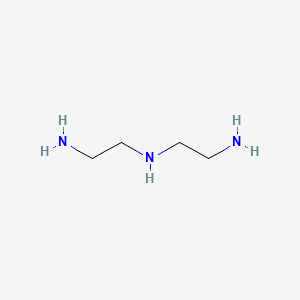
Diethylenetriamine
Diethylenetriamine is a triamine and a polyazaalkane. — ChEBI
- IUPAC-Name
- N'-(2-aminoethyl)ethane-1,2-diamine
- Summenformel
- C4H13N3
- Molekulargewicht
- 103.17 g/mol
- Exakte Masse
- 103.110947427 Da
- XLogP3
- -2,1
- Topologische polare Oberfläche
- 64,1 Ų
- Wasserstoffbrücken-Donoren
- 3
- Wasserstoffbrücken-Akzeptoren
- 3
- Kovalente Einheiten
- 1
- Definierte Stereozentren
- 0
Auch bekannt als
16 weitere gemeldete Namen
Kennungen in externen Datenbanken
- ChEBI:CHEBI:30629
- ChEMBL:CHEMBL303429
- EPA DTXSID:DTXSID2025050
- PubMed:23027087
- PubMed:23026258
- PubMed:22938725
- PubMed:22922614
- PubMed:22898051
- PubMed:22889556
- PubMed:22864525
- PubMed:22820874
- PubMed:22785253
- PubMed:22776854
- PubMed:22750686
- PubMed:22701373
Belege aus weiteren wissenschaftlichen Datenbanken
NIH PubChem PUG-View
Attributed physical-property, hazard, environmental and use annotations.
- Autoignition Temperature: 676 °F (USCG, 1999) Quelle: CAMEO Chemicals
- Autoignition Temperature: 398.9 °C Quelle: Hazardous Substances Data Bank (HSDB)
- Autoignition Temperature: 358 °C Quelle: ILO-WHO International Chemical Safety Cards (ICSCs)
- Boiling Point: 405 °F at 760 mmHg (NTP, 1992) Quelle: CAMEO Chemicals
- Boiling Point: 207 °C @ 760 MM HG Quelle: Hazardous Substances Data Bank (HSDB)
- Boiling Point: 207.00 °C. @ 760.00 mm Hg Quelle: Human Metabolome Database (HMDB)
- Boiling Point: 207 °C Quelle: ILO-WHO International Chemical Safety Cards (ICSCs)
- Boiling Point: 405 °F Quelle: Occupational Safety and Health Administration (OSHA)
- Boiling Point: 207 °C @760 [mm Hg] Quelle: PAC Chemical Database, U.S. Department of Energy
- Boiling Point: 405 °F Quelle: The National Institute for Occupational Safety and Health (NIOSH)
- Color/Form: YELLOW LIQUID Quelle: Hazardous Substances Data Bank (HSDB)
- Color/Form: Colorless liquid Quelle: Hazardous Substances Data Bank (HSDB)
- Color/Form: Colorless to yellow liquid ... [Note: Hygroscopic (i.e., absorbs moisture from the air)]. Quelle: Hazardous Substances Data Bank (HSDB)
- Density: 0.954 at 68 °F (USCG, 1999) - Less dense than water; will float Quelle: CAMEO Chemicals
- Density: 0.9586 @ 20 °C/20 °C Quelle: Hazardous Substances Data Bank (HSDB)
- Density: Relative density (water = 1): 0.96 Quelle: ILO-WHO International Chemical Safety Cards (ICSCs)
- Density: 0.96 Quelle: Occupational Safety and Health Administration (OSHA)
- Density: 0.9586 @ 20°C Quelle: PAC Chemical Database, U.S. Department of Energy
- Density: 0.96 Quelle: The National Institute for Occupational Safety and Health (NIOSH)
- Dissociation Constants: Kb = 7.07X10⁻⁵ Quelle: Hazardous Substances Data Bank (HSDB)
- Dissociation Constants: pKa = 10.45 @ 20 °C Quelle: Hazardous Substances Data Bank (HSDB)
- Flash Point: 215 °F (NTP, 1992) Quelle: CAMEO Chemicals
- Flash Point: 101 °C Quelle: Haz-Map, Information on Hazardous Chemicals and Occupational Diseases
- Flash Point: 101.7 °C (Open cup) Quelle: Hazardous Substances Data Bank (HSDB)
- Flash Point: 97 °C c.c., 102 °C o.c. Quelle: ILO-WHO International Chemical Safety Cards (ICSCs)
- Flash Point: 208 °F Quelle: Occupational Safety and Health Administration (OSHA)
- Flash Point: 208 °F Quelle: The National Institute for Occupational Safety and Health (NIOSH)
- LogP: -1.3 Quelle: ILO-WHO International Chemical Safety Cards (ICSCs)
- Melting Point: -38 °F (NTP, 1992) Quelle: CAMEO Chemicals
- Melting Point: -39 °C Quelle: Hazardous Substances Data Bank (HSDB)
- Melting Point: -39 °C Quelle: Human Metabolome Database (HMDB)
- Melting Point: -39 °C Quelle: ILO-WHO International Chemical Safety Cards (ICSCs)
- Melting Point: -38 °F Quelle: Occupational Safety and Health Administration (OSHA)
- Melting Point: -39 °C Quelle: PAC Chemical Database, U.S. Department of Energy
- Melting Point: -38 °F Quelle: The National Institute for Occupational Safety and Health (NIOSH)
- Odor: AMMONIACAL ODOR Quelle: Hazardous Substances Data Bank (HSDB)
- Odor: ... Strong, ammonia-like odor ... Quelle: Hazardous Substances Data Bank (HSDB)
- Physical Description: Diethylenetriamine appears as a yellow liquid with an ammonia-like odor. Less dense than water. Corrosive to metals and tissue. Vapors heavier than air. Burns, although possibly difficult to igntie. Toxic oxides of nitrogen produced during combustion. Used as a solvent for plastics and dyes and in chemical synthesis. Quelle: CAMEO Chemicals
- Physical Description: Liquid; CBI Quelle: EPA Chemical Data Reporting (CDR)
- Physical Description: Colorless to yellow liquid with a strong, ammonia-like odor; Note: Hygroscopic (i.e., absorbs moisture from the air); [NIOSH] Quelle: Haz-Map, Information on Hazardous Chemicals and Occupational Diseases
- Physical Description: Liquid Quelle: Human Metabolome Database (HMDB)
- Physical Description: COLOURLESS-TO-YELLOW VISCOUS HYGROSCOPIC LIQUID WITH CHARACTERISTIC ODOUR. Quelle: ILO-WHO International Chemical Safety Cards (ICSCs)
- Physical Description: Colorless to yellow liquid with a strong, ammonia-like odor. Quelle: Occupational Safety and Health Administration (OSHA)
- Physical Description: Colorless to yellow liquid with a strong, ammonia-like odor. [Note: Hygroscopic (i.e., absorbs moisture from the air).] Quelle: The National Institute for Occupational Safety and Health (NIOSH)
- Refractive Index: INDEX OF REFRACTION: 1.4810 @ 25 °C/D Quelle: Hazardous Substances Data Bank (HSDB)
- Solubility: Very soluble (NTP, 1992) Quelle: CAMEO Chemicals
- Solubility: SOL IN ALL PROP IN WATER & ALC; INSOL IN ETHER; SOL IN PETROLEUM ETHER Quelle: Hazardous Substances Data Bank (HSDB)
- Solubility: SOL IN HYDROCARBONS Quelle: Hazardous Substances Data Bank (HSDB)
- Solubility: miscible with water, methanol, acetone, ether, and benzene, but insoluble in heptane Quelle: Hazardous Substances Data Bank (HSDB)
- Solubility: water solubility = 1X10+6 mg/l Quelle: Hazardous Substances Data Bank (HSDB)
- Solubility: 1000 mg/mL Quelle: Human Metabolome Database (HMDB)
- Solubility: Solubility in water: miscible Quelle: ILO-WHO International Chemical Safety Cards (ICSCs)
- Solubility: Miscible Quelle: The National Institute for Occupational Safety and Health (NIOSH)
- Vapor Pressure: 0.22 mmHg at 68 °F (NTP, 1992) Quelle: CAMEO Chemicals
- Vapor Pressure: 0.23 [mmHg] Quelle: Haz-Map, Information on Hazardous Chemicals and Occupational Diseases
- Vapor Pressure: Vapor pressure: 0.23 mm Hg at 25 °C Quelle: Hazardous Substances Data Bank (HSDB)
- Vapor Pressure: 0.232 mm Hg @ 25 °C Quelle: Hazardous Substances Data Bank (HSDB)
- Vapor Pressure: Vapor pressure, Pa at 20 °C: 37 Quelle: ILO-WHO International Chemical Safety Cards (ICSCs)
- Vapor Pressure: 0.4 mmHg Quelle: Occupational Safety and Health Administration (OSHA)
- Vapor Pressure: 0.22 [mm Hg] @20 °C Quelle: PAC Chemical Database, U.S. Department of Energy
- Vapor Pressure: 0.4 mmHg Quelle: The National Institute for Occupational Safety and Health (NIOSH)
- Viscosity: 0.0714 POISE @ 20 °C Quelle: Hazardous Substances Data Bank (HSDB)
- pH: STRONGLY ALKALINE Quelle: Hazardous Substances Data Bank (HSDB)
- Carcinogen Classification: No indication of carcinogenicity to humans (not listed by IARC). Quelle: Toxin and Toxin Target Database (T3DB)
- Exposure Routes: The substance can be absorbed into the body by inhalation of its vapour, through the skin and by ingestion. Quelle: ILO-WHO International Chemical Safety Cards (ICSCs)
- Exposure Routes: inhalation, skin absorption, ingestion, skin and/or eye contact Quelle: The National Institute for Occupational Safety and Health (NIOSH)
- First Aid: EYES: First check the victim for contact lenses and remove if present. Flush victim's eyes with water or normal saline solution for 20 to 30 minutes while simultaneously calling a hospital or poison control center. Do not put any ointments, oils, or medication in the victim's eyes without specific instructions from a physician. IMMEDIATELY transport the victim after flushing eyes to a hospital even if no symptoms (such as redness or irritation) develop.; SKIN: IMMEDIATELY flood affected skin with water while removing and isolating all contaminated clothing. Gently wash all affected skin areas thoroughly with soap and water. IMMEDIATELY call a hospital or poison control center even if no symptoms (such as redness or irritation) develop. IMMEDIATELY transport the victim to a hospital for treatment after washing the affected areas.; INHALATION: IMMEDIATELY leave the contaminated area; take deep breaths of fresh air. If symptoms (such as wheezing, coughing, shortness of breath, or burning in the mouth, throat, or chest) develop, call a physician and be prepared to transport the victim to a hospital. Provide proper respiratory protection to rescuers entering an unknown atmosphere. Whene Quelle: CAMEO Chemicals
- ERG2024, Guide 154 (Diethylenetriamine): General First Aid:; · Call 911 or emergency medical service.; · Ensure that medical personnel are aware of the material(s) involved, take precautions to protect themselves and avoid contamination.; · Move victim to fresh air if it can be done safely.; · Administer oxygen if breathing is difficult.; · If victim is not breathing:; -- DO NOT perform mouth-to-mouth resuscitation; the victim may have ingested or inhaled the substance.; -- If equipped and pulse detected, wash face and mouth, then give artificial respiration using a proper respiratory medical device (bag-valve mask, pocket mask equipped with a one-way valve or other device).; -- If no pulse detected or no respiratory medical device available, provide continuous compressions. Conduct a pulse check every two minutes or monitor for any signs of spontaneous respirations.; · Remove and isolate contaminated clothing and shoes.; · For minor skin contact, avoid spreading material on unaffected skin.; · In case of contact with substance, remove immediately by flushing skin or eyes with running water for at least 20 minutes.; · For severe burns, immediate medical attention is required.; · Effects of exposure (inhalation, ingestion, Quelle: Emergency Response Guidebook (ERG)
- First Aid: (General first aid procedures); Eye: Irrigate immediately - If this chemical contacts the eyes, immediately wash (irrigate) the eyes with large amounts of water, occasionally lifting the lower and upper lids. Get medical attention immediately.; Skin: Water flush immediately - If this chemical contacts the skin, immediately flush the contaminated skin with water. If this chemical penetrates the clothing, immediately remove the clothing and flush the skin with water. Get medical attention promptly.; Breathing: Respiratory support; Swallow: Medical attention immediately - If this chemical has been swallowed, get medical attention immediately. Quelle: The National Institute for Occupational Safety and Health (NIOSH)
- Signal: Danger Quelle: Regulation (EC) No 1272/2008 of the European Parliament and of the Council
- GHS Hazard Statements: H302: Harmful if swallowed [Warning Acute toxicity, oral]; H312: Harmful in contact with skin [Warning Acute toxicity, dermal]; H314: Causes severe skin burns and eye damage [Danger Skin corrosion/irritation]; H317: May cause an allergic skin reaction [Warning Sensitization, Skin] Quelle: Regulation (EC) No 1272/2008 of the European Parliament and of the Council
- Precautionary Statement Codes: P260, P261, P264, P270, P272, P280, P301+P317, P301+P330+P331, P302+P352, P302+P361+P354, P304+P340, P305+P354+P338, P316, P317, P321, P330, P333+P317, P362+P364, P363, P405, and P501 (click each P-code to see the statement) Quelle: Regulation (EC) No 1272/2008 of the European Parliament and of the Council
- Note: This chemical does not meet GHS hazard criteria for < 0.1% (2 of 3716) of reports. Quelle: European Chemicals Agency (ECHA)
- Signal: Danger Quelle: European Chemicals Agency (ECHA)
- GHS Hazard Statements: H302 (> 99.9%): Harmful if swallowed [Warning Acute toxicity, oral]; H312 (95.2%): Harmful in contact with skin [Warning Acute toxicity, dermal]; H314 (> 99.9%): Causes severe skin burns and eye damage [Danger Skin corrosion/irritation]; H317 (> 99.9%): May cause an allergic skin reaction [Warning Sensitization, Skin]; H318 (68.3%): Causes serious eye damage [Danger Serious eye damage/eye irritation]; H330 (71.7%): Fatal if inhaled [Danger Acute toxicity, inhalation]; H335 (70.7%): May cause respiratory irritation [Warning Specific target organ toxicity, single exposure; Respiratory tract irritation] Quelle: European Chemicals Agency (ECHA)
- Precautionary Statement Codes: P260, P261, P264, P264+P265, P270, P271, P272, P280, P284, P301+P317, P301+P330+P331, P302+P352, P302+P361+P354, P304+P340, P305+P354+P338, P316, P317, P319, P320, P321, P330, P333+P317, P362+P364, P363, P403+P233, P405, and P501 (click each P-code to see the statement) Quelle: European Chemicals Agency (ECHA)
- ECHA C&L Notifications Summary: Aggregated GHS information provided per 3716 reports by companies from 49 notifications to the ECHA C&L Inventory. Each notification may be associated with multiple companies.; Reported as not meeting GHS hazard criteria per 2 of 3716 reports by companies.; There are 48 notifications provided by 3714 of 3716 reports by companies with hazard statement code(s).; Information may vary between notifications depending on impurities, additives, and other factors. The percentage value in parenthesis indicates the notified classification ratio from companies that provide hazard codes. Only hazard codes with percentage values above 10% are shown. For more detailed information, please visit ECHA C&L website. Quelle: European Chemicals Agency (ECHA)
- GHS Hazard Statements: H411 (100%): Toxic to aquatic life with long lasting effects [Hazardous to the aquatic environment, long-term hazard] Quelle: European Chemicals Agency (ECHA)
- Precautionary Statement Codes: P273, P391, and P501 (click each P-code to see the statement) Quelle: European Chemicals Agency (ECHA)
- ECHA C&L Notifications Summary: The GHS information provided by 1 company from 1 notification to the ECHA C&L Inventory. Quelle: European Chemicals Agency (ECHA)
- Signal: Danger Quelle: NITE-CMC
- Target Organs: Eyes, skin, respiratory system Quelle: The National Institute for Occupational Safety and Health (NIOSH)
- Environmental Bioconcentration: Diethylenetriamine has a very low estimated log octanol/water partition coefficient, -2.13(1), and, therefore, would not be expected to bioconcentrate in fish(SRC). Quelle: Hazardous Substances Data Bank (HSDB)
- Environmental Fate: TERRESTRIAL FATE: If released on land, diethylenetriamine would principally leach into the ground. The only circumstance where biodegradation would be significant is where the microorganisms at the site are well acclimated. Some of the diethylenetriamine may volatilize from the soil surface. (SRC) Quelle: Hazardous Substances Data Bank (HSDB)
- Environmental Fate: AQUATIC FATE: The fate of diethylenetriamine released into water is unknown. Volatilization and adsorption to sediment will not be significant loss mechanisms. Biodegradation would not be expected to be significant unless the microorganisms at the site were well acclimated. (SRC) Quelle: Hazardous Substances Data Bank (HSDB)
- Environmental Fate: ATMOSPHERIC FATE: Diethylenetriamine emitted to the atmosphere will degrade by reaction with photochemically produced hydroxyl radicals. The estimated half-life for this reaction is 2.7 hr(1,SRC). Quelle: Hazardous Substances Data Bank (HSDB)
- Consumer Uses: Hardener; Paint additives and coating additives not described by other categories; Not Known or Reasonably Ascertainable Quelle: EPA Chemical Data Reporting (CDR)
- Industry Uses: Not Known or Reasonably Ascertainable; Corrosion inhibitor; Paint additives and coating additives not described by other categories; Intermediate; Hardener; Lubricating agent; CBI; Other; Solvent; Processing aids not otherwise specified Quelle: EPA Chemical Data Reporting (CDR)
- Sources/Uses: Used as a solvent, fuel component, and saponification agent; [ACGIH] Used in the production of epoxy resin curing agents and reactive polyamide resins; [HSDB] Quelle: Haz-Map, Information on Hazardous Chemicals and Occupational Diseases
- Industrial Processes with risk of exposure: Plastic Composites Manufacturing [Category: Industry] Quelle: Haz-Map, Information on Hazardous Chemicals and Occupational Diseases
- Uses: CHEM INT FOR REACTIVE POLYAMIDE RESINS, FATTY AMINOAMIDES, FATTY IMIDAZOLINES. Quelle: Hazardous Substances Data Bank (HSDB)
- Uses: SOLVENT FOR SULFUR, ACID GASES, VARIOUS RESINS, DYES; SAPONIFICATION AGENT FOR ACIDIC MATERIALS. Quelle: Hazardous Substances Data Bank (HSDB)
- Uses: In the synthesis of polymer antistatic agents for textiles Quelle: Hazardous Substances Data Bank (HSDB)
- Uses: In synthesis of 2-part epoxy amine hardeners Quelle: Hazardous Substances Data Bank (HSDB)
- Uses: For more Uses (Complete) data for DIETHYLENETRIAMINE (13 total), please visit the HSDB record page. Quelle: Hazardous Substances Data Bank (HSDB)
Zugeordnet durch: Existing checksum-valid CAS to unique PubChem CID match. Abgerufen: 2026-08-31. Quelleneintrag öffnen
Wissenschaftliche Klassifizierungen und Gefahrenannotationen liefern Kontext und ersetzen nicht die oben gezeigte marktspezifische regulatorische Entscheidung.
Weitere Quellenabdeckung und Trefferstatus
| Quelle | Ergebnis | Geprüft |
|---|---|---|
| NIH PubChem PUG-View | Exakter Treffer | 2026-08-31 |
Ein erfasster Nicht-Treffer ist ein nützlicher Beleg dafür, dass die Quelle geprüft wurde; er ist keine Behauptung, dass der Stoff anderswo nicht existiert.
Am 2026-08-31 von NIH PubChem durch prüfsummengültigen CAS-Abgleich abgerufen. Chemische Eigenschaften ersetzen nicht die regulatorische Entscheidung auf dieser Seite.