
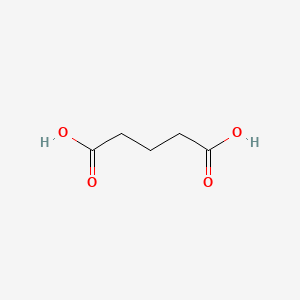
Glutaric Acid
Glutaric acid is an alpha,-dicarboxylic acid that is a linear five-carbon dicarboxylic acid. It has a role as a human metabolite and a Daphnia magna metabolite. It is a dicarboxylic fatty acid and an alpha,omega-dicarboxylic acid. It is a conjugate acid of a glutarate and a glutarate(1-). — ChEBI
- IUPAC-Name
- pentanedioic acid
- Summenformel
- C5H8O4
- Molekulargewicht
- 132.11 g/mol
- Exakte Masse
- 132.04225873 Da
- XLogP3
- -0,3
- Topologische polare Oberfläche
- 74,6 Ų
- Wasserstoffbrücken-Donoren
- 2
- Wasserstoffbrücken-Akzeptoren
- 4
- Kovalente Einheiten
- 1
- Definierte Stereozentren
- 0
Auch bekannt als
16 weitere gemeldete Namen
Kennungen in externen Datenbanken
- ChEBI:CHEBI:17859
- ChEMBL:CHEMBL1162495
- EPA DTXSID:DTXSID2021654
- PubMed:22968940
- PubMed:22863851
- PubMed:22728054
- PubMed:22717263
- PubMed:22701277
- PubMed:22696041
- PubMed:22693458
- PubMed:22675387
- PubMed:22639756
- PubMed:22610679
- PubMed:22593763
- PubMed:22584219
Belege aus weiteren wissenschaftlichen Datenbanken
NIH PubChem PUG-View
Attributed physical-property, hazard, environmental and use annotations.
- Boiling Point: 576 to 579 °F at 760 mmHg (decomposes) (NTP, 1992) Quelle: CAMEO Chemicals
- Boiling Point: 303 °C Quelle: DrugBank
- Boiling Point: 200 °C @ 20 MM HG Quelle: Hazardous Substances Data Bank (HSDB)
- Boiling Point: 303.00 °C. @ 760.00 mm Hg Quelle: Human Metabolome Database (HMDB)
- Color/Form: LARGE, MONOCLINIC PRISMS Quelle: Hazardous Substances Data Bank (HSDB)
- Color/Form: COLORLESS CRYSTALS Quelle: Hazardous Substances Data Bank (HSDB)
- Density: 1.424 at 77 °F (NTP, 1992) - Denser than water; will sink Quelle: CAMEO Chemicals
- Density: 1.429 @ 15 °C/4 °C Quelle: Hazardous Substances Data Bank (HSDB)
- Density: 1.4 g/cm³ Quelle: ILO-WHO International Chemical Safety Cards (ICSCs)
- pKa: 4.34 (at 25 °C) Quelle: DrugBank
- Dissociation Constants: K1 @ 25 DEG: 4.60X10⁻⁵; K2: 6.0X10⁻⁶ Quelle: Hazardous Substances Data Bank (HSDB)
- LogP: -0.29 Quelle: DrugBank
- LogP: -0.29 Quelle: Human Metabolome Database (HMDB)
- LogP: -0.47/-0.08 (calculated) Quelle: ILO-WHO International Chemical Safety Cards (ICSCs)
- Melting Point: 207.5 °F (NTP, 1992) Quelle: CAMEO Chemicals
- Melting Point: 97.8 °C Quelle: DrugBank
- Melting Point: 97.5-98 °C Quelle: Hazardous Substances Data Bank (HSDB)
- Melting Point: 95.8 °C Quelle: Human Metabolome Database (HMDB)
- Melting Point: 98 °C Quelle: ILO-WHO International Chemical Safety Cards (ICSCs)
- Physical Description: Glutaric acid appears as colorless crystals or white solid. (NTP, 1992) Quelle: CAMEO Chemicals
- Physical Description: Liquid; Other Solid; Liquid; CBI; Dry Powder Quelle: EPA Chemical Data Reporting (CDR)
- Physical Description: Colorless or white solid; [CAMEO] Fine faintly red crystals; [MSDSonline] Quelle: Haz-Map, Information on Hazardous Chemicals and Occupational Diseases
- Physical Description: Solid Quelle: Human Metabolome Database (HMDB)
- Physical Description: COLOURLESS CRYSTALS. Quelle: ILO-WHO International Chemical Safety Cards (ICSCs)
- Refractive Index: INDEX OF REFRACTION: 1.41878 @ 106 °C/D Quelle: Hazardous Substances Data Bank (HSDB)
- Solubility: greater than or equal to 100 mg/mL at 70 °F (NTP, 1992) Quelle: CAMEO Chemicals
- Solubility: 1600000 mg/L (at 28 °C) Quelle: DrugBank
- Solubility: SOLUBILITY IN WATER (G/L): @ 0 DEG: 429; @ 20 DEG: 639; @ 50 DEG: 957; @ 65 DEG: 1118; FREELY SOL IN ABSOLUTE ALCOHOL, ETHER; SOL IN BENZENE, CHLOROFORM; SLIGHTLY SOL IN PETROLEUM ETHER Quelle: Hazardous Substances Data Bank (HSDB)
- Solubility: SOL IN CONCENTRATED SULFURIC ACID Quelle: Hazardous Substances Data Bank (HSDB)
- Solubility: 1600.0 mg/mL Quelle: Human Metabolome Database (HMDB)
- Solubility: Solubility in water, g/100ml at 20 °C: 63.9 Quelle: ILO-WHO International Chemical Safety Cards (ICSCs)
- Vapor Pressure: 1 mmHg at 311.9 °F ; 10 mmHg at 384.8 °F (NTP, 1992) Quelle: CAMEO Chemicals
- Vapor Pressure: 0.00000288 [mmHg] Quelle: Haz-Map, Information on Hazardous Chemicals and Occupational Diseases
- Carcinogen Classification: No indication of carcinogenicity to humans (not listed by IARC). Quelle: Toxin and Toxin Target Database (T3DB)
- Exposure Routes: The substance can be absorbed into the body by inhalation of its aerosol. Quelle: ILO-WHO International Chemical Safety Cards (ICSCs)
- First Aid: EYES: First check the victim for contact lenses and remove if present. Flush victim's eyes with water or normal saline solution for 20 to 30 minutes while simultaneously calling a hospital or poison control center. Do not put any ointments, oils, or medication in the victim's eyes without specific instructions from a physician. IMMEDIATELY transport the victim after flushing eyes to a hospital even if no symptoms (such as redness or irritation) develop.; SKIN: IMMEDIATELY flood affected skin with water while removing and isolating all contaminated clothing. Gently wash all affected skin areas thoroughly with soap and water. If symptoms such as redness or irritation develop, IMMEDIATELY call a physician and be prepared to transport the victim to a hospital for treatment.; INHALATION: IMMEDIATELY leave the contaminated area; take deep breaths of fresh air. If symptoms (such as wheezing, coughing, shortness of breath, or burning in the mouth, throat, or chest) develop, call a physician and be prepared to transport the victim to a hospital. Provide proper respiratory protection to rescuers entering an unknown atmosphere. Whenever possible, Self-Contained Breathing Apparatus (SCBA) shou Quelle: CAMEO Chemicals
- Note: This chemical does not meet GHS hazard criteria for 3.7% (13 of 350) of reports. Quelle: European Chemicals Agency (ECHA)
- Signal: Danger Quelle: European Chemicals Agency (ECHA)
- GHS Hazard Statements: H314 (49.7%): Causes severe skin burns and eye damage [Danger Skin corrosion/irritation]; H318 (53.4%): Causes serious eye damage [Danger Serious eye damage/eye irritation]; H319 (42.9%): Causes serious eye irritation [Warning Serious eye damage/eye irritation] Quelle: European Chemicals Agency (ECHA)
- Precautionary Statement Codes: P260, P264, P264+P265, P280, P301+P330+P331, P302+P361+P354, P304+P340, P305+P351+P338, P305+P354+P338, P316, P317, P321, P337+P317, P363, P405, and P501 (click each P-code to see the statement) Quelle: European Chemicals Agency (ECHA)
- ECHA C&L Notifications Summary: Aggregated GHS information provided per 350 reports by companies from 11 notifications to the ECHA C&L Inventory. Each notification may be associated with multiple companies.; Reported as not meeting GHS hazard criteria per 13 of 350 reports by companies.; There are 10 notifications provided by 337 of 350 reports by companies with hazard statement code(s).; Information may vary between notifications depending on impurities, additives, and other factors. The percentage value in parenthesis indicates the notified classification ratio from companies that provide hazard codes. Only hazard codes with percentage values above 10% are shown. For more detailed information, please visit ECHA C&L website. Quelle: European Chemicals Agency (ECHA)
- Health Effects: Chronically high levels of glutaric acid are associated with at least 3 inborn errors of metabolism including: Glutaric Aciduria Type I and Glutaric Aciduria Type III. Quelle: Toxin and Toxin Target Database (T3DB)
- Cosmetic Ingredient Review Finding(s): Safe in the present practices of use and concentration. Ingredient, concentration, and use information are available in documents discoverable at https://cir-reports.cir-safety.org Quelle: Cosmetic Ingredient Review (CIR)
- Toxicity Summary: Accumulation of glutaric acid in the body has been shown to be toxic. The accumulation of glutaric acid ranging from slightly or intermittently elevated urinary glutaric acid to gross organic aciduria occurs in glutaric aciduria. Glutaric aciduria type 1 is an autosomal-recessive disorder resulting from a deficiency of mitochondrial glutaryl-CoA dehydrogenase which is involved in the metabolism of lysine, hydroxylysine, and tryptophan. Quelle: Toxin and Toxin Target Database (T3DB)
- Consumer Uses: Not Known or Reasonably Ascertainable Quelle: EPA Chemical Data Reporting (CDR)
- Industry Uses: Intermediate; Not Known or Reasonably Ascertainable; Absorbent; Plasticizer; pH regulating agent; Processing aids not otherwise specified; Tanning agents not otherwise specified; Lubricating agent Quelle: EPA Chemical Data Reporting (CDR)
- Cosmetic Ingredient Review Link: CIR ingredient: Glutaric Acid Quelle: Cosmetic Ingredient Review (CIR)
- Sources/Uses: Present in green sugar beets and water extracts of crude wool; [Merck Index] Used to make polymers, for biochemical research, and to treat animal diabetes; [HSDB] Quelle: Haz-Map, Information on Hazardous Chemicals and Occupational Diseases
- Uses: IN ORGANIC SYNTHESIS Quelle: Hazardous Substances Data Bank (HSDB)
- Uses: CHEM INT FOR POLYMERS, EG, POLYAMIDES & POLYESTERS Quelle: Hazardous Substances Data Bank (HSDB)
- Uses: CHEM INT FOR ITS ESTERS & ANHYDRIDE Quelle: Hazardous Substances Data Bank (HSDB)
- Uses: MEDICATION Quelle: Hazardous Substances Data Bank (HSDB)
- Uses: MEDICATION (VET) Quelle: Hazardous Substances Data Bank (HSDB)
- Uses: This is an endogenously produced metabolite found in the human body. It is used in metabolic reactions, catabolic reactions or waste generation. Quelle: Toxin and Toxin Target Database (T3DB)
Zugeordnet durch: Existing checksum-valid CAS to unique PubChem CID match. Abgerufen: 2026-08-31. Quelleneintrag öffnen
Wissenschaftliche Klassifizierungen und Gefahrenannotationen liefern Kontext und ersetzen nicht die oben gezeigte marktspezifische regulatorische Entscheidung.
Weitere Quellenabdeckung und Trefferstatus
| Quelle | Ergebnis | Geprüft |
|---|---|---|
| NIH PubChem PUG-View | Exakter Treffer | 2026-08-31 |
Ein erfasster Nicht-Treffer ist ein nützlicher Beleg dafür, dass die Quelle geprüft wurde; er ist keine Behauptung, dass der Stoff anderswo nicht existiert.
Am 2026-08-31 von NIH PubChem durch prüfsummengültigen CAS-Abgleich abgerufen. Chemische Eigenschaften ersetzen nicht die regulatorische Entscheidung auf dieser Seite.