
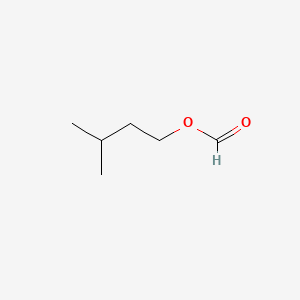
Isoamyl formate
Isoamyl formate is the formate ester of isoamylol. It is functionally related to an isoamylol. — ChEBI
- IUPAC-Name
- 3-methylbutyl formate
- Summenformel
- C6H12O2
- Molekulargewicht
- 116.16 g/mol
- Exakte Masse
- 116.083729621 Da
- XLogP3
- 1,8
- Topologische polare Oberfläche
- 26,3 Ų
- Wasserstoffbrücken-Donoren
- 0
- Wasserstoffbrücken-Akzeptoren
- 2
- Kovalente Einheiten
- 1
- Definierte Stereozentren
- 0
Auch bekannt als
16 weitere gemeldete Namen
Kennungen in externen Datenbanken
- ChEBI:CHEBI:31726
- EPA DTXSID:DTXSID00861734
Belege aus weiteren wissenschaftlichen Datenbanken
NIH PubChem PUG-View
Attributed physical-property, hazard, environmental and use annotations.
- Boiling Point: 123.00 to 124.00 °C. @ 760.00 mm Hg Quelle: Human Metabolome Database (HMDB)
- Boiling Point: 124 °C Quelle: Joint FAO/WHO Expert Committee on Food Additives (JECFA)
- Density: 0.881-0.889 Quelle: Joint FAO/WHO Expert Committee on Food Additives (JECFA)
- Melting Point: -93.5 °C Quelle: Human Metabolome Database (HMDB)
- Physical Description: Liquid Quelle: Human Metabolome Database (HMDB)
- Physical Description: colourless liquid with a plum-like odour Quelle: Joint FAO/WHO Expert Committee on Food Additives (JECFA)
- Refractive Index: 1.396-1.400 Quelle: Joint FAO/WHO Expert Committee on Food Additives (JECFA)
- Solubility: 3.5 mg/mL at 25 °C Quelle: Human Metabolome Database (HMDB)
- Solubility: soluble in ethanol, most fixed oils and propylene glycol, slightly soluble in water, insoluble in glycerol Quelle: Joint FAO/WHO Expert Committee on Food Additives (JECFA)
- Solubility: 1ml in 40ml 60% ethanol (in ethanol) Quelle: Joint FAO/WHO Expert Committee on Food Additives (JECFA)
- Signal: Danger Quelle: Regulation (EC) No 1272/2008 of the European Parliament and of the Council
- GHS Hazard Statements: H225: Highly Flammable liquid and vapor [Danger Flammable liquids]; H319: Causes serious eye irritation [Warning Serious eye damage/eye irritation]; H335: May cause respiratory irritation [Warning Specific target organ toxicity, single exposure; Respiratory tract irritation] Quelle: Regulation (EC) No 1272/2008 of the European Parliament and of the Council
- Precautionary Statement Codes: P210, P233, P240, P241, P242, P243, P261, P264+P265, P271, P280, P303+P361+P353, P304+P340, P305+P351+P338, P319, P337+P317, P370+P378, P403+P233, P403+P235, P405, and P501 (click each P-code to see the statement) Quelle: Regulation (EC) No 1272/2008 of the European Parliament and of the Council
- Note: This chemical does not meet GHS hazard criteria for 0.7% (11 of 1650) of reports. Quelle: European Chemicals Agency (ECHA)
- Signal: Danger Quelle: European Chemicals Agency (ECHA)
- GHS Hazard Statements: H225 (96.6%): Highly Flammable liquid and vapor [Danger Flammable liquids]; H319 (99.3%): Causes serious eye irritation [Warning Serious eye damage/eye irritation]; H335 (99.3%): May cause respiratory irritation [Warning Specific target organ toxicity, single exposure; Respiratory tract irritation] Quelle: European Chemicals Agency (ECHA)
- Precautionary Statement Codes: P210, P233, P240, P241, P242, P243, P261, P264+P265, P271, P280, P303+P361+P353, P304+P340, P305+P351+P338, P319, P337+P317, P370+P378, P403+P233, P403+P235, P405, and P501 (click each P-code to see the statement) Quelle: European Chemicals Agency (ECHA)
- ECHA C&L Notifications Summary: Aggregated GHS information provided per 1650 reports by companies from 16 notifications to the ECHA C&L Inventory. Each notification may be associated with multiple companies.; Reported as not meeting GHS hazard criteria per 11 of 1650 reports by companies.; There are 15 notifications provided by 1639 of 1650 reports by companies with hazard statement code(s).; Information may vary between notifications depending on impurities, additives, and other factors. The percentage value in parenthesis indicates the notified classification ratio from companies that provide hazard codes. Only hazard codes with percentage values above 10% are shown. For more detailed information, please visit ECHA C&L website. Quelle: European Chemicals Agency (ECHA)
- Signal: Danger Quelle: NITE-CMC
- GHS Hazard Statements: H225: Highly Flammable liquid and vapor [Danger Flammable liquids] Quelle: NITE-CMC
- Precautionary Statement Codes: P210, P233, P240, P241, P242, P243, P280, P303+P361+P353, P370+P378, P403+P235, and P501 (click each P-code to see the statement) Quelle: NITE-CMC
- Signal: Danger Quelle: Hazardous Chemical Information System (HCIS), Safe Work Australia
Zugeordnet durch: Existing checksum-valid CAS to unique PubChem CID match. Abgerufen: 2026-08-31. Quelleneintrag öffnen
Wissenschaftliche Klassifizierungen und Gefahrenannotationen liefern Kontext und ersetzen nicht die oben gezeigte marktspezifische regulatorische Entscheidung.
Weitere Quellenabdeckung und Trefferstatus
| Quelle | Ergebnis | Geprüft |
|---|---|---|
| NIH PubChem PUG-View | Exakter Treffer | 2026-08-31 |
Ein erfasster Nicht-Treffer ist ein nützlicher Beleg dafür, dass die Quelle geprüft wurde; er ist keine Behauptung, dass der Stoff anderswo nicht existiert.
Am 2026-08-31 von NIH PubChem durch prüfsummengültigen CAS-Abgleich abgerufen. Chemische Eigenschaften ersetzen nicht die regulatorische Entscheidung auf dieser Seite.