
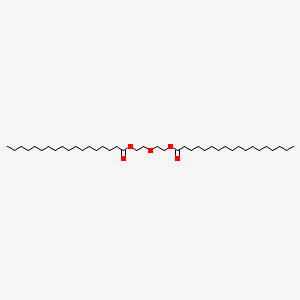
1,1'-(Oxydi-2,1-ethanediyl) dioctadecanoate
The CIR Expert Panel concluded that butylene glycol diisononanoate, cetearyl isononanoate, cetearyl nonanoate, cetyl isononanoate, cholesteryl nonanoate, diethylene glycol diethyl-hexanoate/ diisononanoate, dipentaerythrityl pentaisononanoate, ethylhexyl isononanoate, isodecyl isononanoate, isononyl isononanoate, isotridecyl isononanoate, neopentyl glycol diisononanoate, PEG-2 diisononanoate, PEG-5 isononanoate, pentaerythrityl tetraisononanaote, polyglyceryl-20 octaisononanoate, tridecyl isononanoate, ethylhexyl pelargonate, pentaerythrityl tetrapelargonate, cellobiose octanonanoate, diethylene glycol diisononanoate, dihydrocholesteryl nonanoate, glycereth-7 diisononanoate, isostearyl isononanoate, phytosteryl nonanoate, propylene glycol diisononanoate, ethyl pelargonate, isobutyl pelargonate, methyl pelargonate, neopentyl glycol dicaprylate/dipelargonate/dicaprate, and pelargonic acid are safe as cosmetic ingredients in the present practices of use and concentration described in this safety assessment. — Cosmetic Ingredient Review (CIR)
- IUPAC-Name
- 2-(2-octadecanoyloxyethoxy)ethyl octadecanoate
- Summenformel
- C40H78O5
- Molekulargewicht
- 639.0 g/mol
- Exakte Masse
- 638.58492558 Da
- XLogP3
- 16,7
- Topologische polare Oberfläche
- 61,8 Ų
- Wasserstoffbrücken-Donoren
- 0
- Wasserstoffbrücken-Akzeptoren
- 5
- Kovalente Einheiten
- 1
- Definierte Stereozentren
- 0
Auch bekannt als
14 weitere gemeldete Namen
Kennungen in externen Datenbanken
- EPA DTXSID:DTXSID80861732
- PubMed:15774011
Belege aus weiteren wissenschaftlichen Datenbanken
NIH PubChem PUG-View
Attributed physical-property, hazard, environmental and use annotations.
- Note: This chemical does not meet GHS hazard criteria for 100% (13 of 13) of all reports. Quelle: European Chemicals Agency (ECHA)
- GHS Hazard Statements: Not Classified; Reported as not meeting GHS hazard criteria by 13 of 13 companies. For more detailed information, please visit ECHA C&L website. Quelle: European Chemicals Agency (ECHA)
- ECHA C&L Notifications Summary: Aggregated GHS information provided per 13 reports by companies from 1 notifications to the ECHA C&L Inventory.; Reported as not meeting GHS hazard criteria per 13 of 13 reports by companies.; There are 0 notifications provided by 0 of 13 reports by companies with hazard statement code(s).; Information may vary between notifications depending on impurities, additives, and other factors. The percentage value in parenthesis indicates the notified classification ratio from companies that provide hazard codes. Only hazard codes with percentage values above 10% are shown. For more detailed information, please visit ECHA C&L website. Quelle: European Chemicals Agency (ECHA)
- Cosmetic Ingredient Review Conclusion: The CIR Expert Panel concluded that butylene glycol diisononanoate, cetearyl isononanoate, cetearyl nonanoate, cetyl isononanoate, cholesteryl nonanoate, diethylene glycol diethyl-hexanoate/ diisononanoate, dipentaerythrityl pentaisononanoate, ethylhexyl isononanoate, isodecyl isononanoate, isononyl isononanoate, isotridecyl isononanoate, neopentyl glycol diisononanoate, PEG-2 diisononanoate, PEG-5 isononanoate, pentaerythrityl tetraisononanaote, polyglyceryl-20 octaisononanoate, tridecyl isononanoate, ethylhexyl pelargonate, pentaerythrityl tetrapelargonate, cellobiose octanonanoate, diethylene glycol diisononanoate, dihydrocholesteryl nonanoate, glycereth-7 diisononanoate, isostearyl isononanoate, phytosteryl nonanoate, propylene glycol diisononanoate, ethyl pelargonate, isobutyl pelargonate, methyl pelargonate, neopentyl glycol dicaprylate/dipelargonate/dicaprate, and pelargonic acid are safe as cosmetic ingredients in the present practices of use and concentration described in this safety assessment. Quelle: Cosmetic Ingredient Review (CIR)
- Cosmetic Ingredient Review Finding(s): Safe for use in cosmetics, with qualifications Quelle: Cosmetic Ingredient Review (CIR)
- Cosmetic Ingredient Review Link: CIR ingredient: PEG-2 Distearate Quelle: Cosmetic Ingredient Review (CIR)
Zugeordnet durch: Existing checksum-valid CAS to unique PubChem CID match. Abgerufen: 2026-08-31. Quelleneintrag öffnen
Wissenschaftliche Klassifizierungen und Gefahrenannotationen liefern Kontext und ersetzen nicht die oben gezeigte marktspezifische regulatorische Entscheidung.
Weitere Quellenabdeckung und Trefferstatus
| Quelle | Ergebnis | Geprüft |
|---|---|---|
| NIH PubChem PUG-View | Exakter Treffer | 2026-08-31 |
Ein erfasster Nicht-Treffer ist ein nützlicher Beleg dafür, dass die Quelle geprüft wurde; er ist keine Behauptung, dass der Stoff anderswo nicht existiert.
Am 2026-08-31 von NIH PubChem durch prüfsummengültigen CAS-Abgleich abgerufen. Chemische Eigenschaften ersetzen nicht die regulatorische Entscheidung auf dieser Seite.