
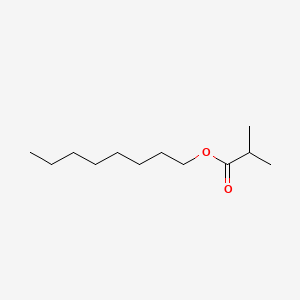
Octyl isobutyrate
Octyl 2-methyl-propionyl is a carboxylic ester. — ChEBI
- IUPAC-Name
- octyl 2-methylpropanoate
- Summenformel
- C12H24O2
- Molekulargewicht
- 200.32 g/mol
- Exakte Masse
- 200.177630004 Da
- XLogP3
- 4,5
- Topologische polare Oberfläche
- 26,3 Ų
- Wasserstoffbrücken-Donoren
- 0
- Wasserstoffbrücken-Akzeptoren
- 2
- Kovalente Einheiten
- 1
- Definierte Stereozentren
- 0
Auch bekannt als
16 weitere gemeldete Namen
Kennungen in externen Datenbanken
- ChEBI:CHEBI:179746
- EPA DTXSID:DTXSID6059364
Belege aus weiteren wissenschaftlichen Datenbanken
NIH PubChem PUG-View
Attributed physical-property, hazard, environmental and use annotations.
- Boiling Point: 236.00 to 238.00 °C. @ 760.00 mm Hg Quelle: Human Metabolome Database (HMDB)
- Boiling Point: 245 °C Quelle: Joint FAO/WHO Expert Committee on Food Additives (JECFA)
- Density: 0.853-0.858 Quelle: Joint FAO/WHO Expert Committee on Food Additives (JECFA)
- Physical Description: colourless to pale yellow liquid/refreshing, herbaceous odour Quelle: Joint FAO/WHO Expert Committee on Food Additives (JECFA)
- Refractive Index: 1.420-1.425 Quelle: Joint FAO/WHO Expert Committee on Food Additives (JECFA)
- Solubility: very slightly Quelle: Human Metabolome Database (HMDB)
- Solubility: 1 ml in 1 ml 95% alcohol (in ethanol) Quelle: Joint FAO/WHO Expert Committee on Food Additives (JECFA)
- Note: This chemical does not meet GHS hazard criteria for 100% (138 of 138) of all reports. Quelle: European Chemicals Agency (ECHA)
- GHS Hazard Statements: Not Classified; Reported as not meeting GHS hazard criteria by 138 of 138 companies. For more detailed information, please visit ECHA C&L website. Quelle: European Chemicals Agency (ECHA)
- ECHA C&L Notifications Summary: Aggregated GHS information provided per 138 reports by companies from 1 notifications to the ECHA C&L Inventory.; Reported as not meeting GHS hazard criteria per 138 of 138 reports by companies.; There are 0 notifications provided by 0 of 138 reports by companies with hazard statement code(s).; Information may vary between notifications depending on impurities, additives, and other factors. The percentage value in parenthesis indicates the notified classification ratio from companies that provide hazard codes. Only hazard codes with percentage values above 10% are shown. For more detailed information, please visit ECHA C&L website. Quelle: European Chemicals Agency (ECHA)
- Toxicity Summary: The existing information was reviewed by the independent Expert Panel for Fragrance Safety and supports the use of octyl isobutyrate as described in this safety assessment. Data from read-across analog hexyl isobutyrate (CAS # 2349-07-7) show that octyl isobutyrate is not expected to be genotoxic. Data on analog propyl (2S)-2-(1,1-dimethylpropoxy)-propanoate (CAS # 319002-92-1) provide a calculated Margin of Exposure (MOE) greater than 100 for the repeated dose and reproductive toxicity endpoints. Data from analog hexyl 2-methylbutyrate (CAS # 10032-15-2) provided octyl isobutyrate a No Expected Sensitization Induction Level (NESIL) of 7000 μg/cm2 for the skin sensitization endpoint. It is not expected to be phototoxic/photoallergenic based on an evaluation of thee ultraviolet/visible (UV/Vis) spectra. The local respiratory toxicity endpoint was evaluated using the Threshold of Toxicological Concern (TTC) for a Cramer Class I material, and the exposure to is below the TTC (1.4 mg/day). Quelle: Pertti (Bert) Hakkinen's Toxicology and Other Annotations
Zugeordnet durch: Existing checksum-valid CAS to unique PubChem CID match. Abgerufen: 2026-08-31. Quelleneintrag öffnen
Wissenschaftliche Klassifizierungen und Gefahrenannotationen liefern Kontext und ersetzen nicht die oben gezeigte marktspezifische regulatorische Entscheidung.
Weitere Quellenabdeckung und Trefferstatus
| Quelle | Ergebnis | Geprüft |
|---|---|---|
| NIH PubChem PUG-View | Exakter Treffer | 2026-08-31 |
Ein erfasster Nicht-Treffer ist ein nützlicher Beleg dafür, dass die Quelle geprüft wurde; er ist keine Behauptung, dass der Stoff anderswo nicht existiert.
Am 2026-08-31 von NIH PubChem durch prüfsummengültigen CAS-Abgleich abgerufen. Chemische Eigenschaften ersetzen nicht die regulatorische Entscheidung auf dieser Seite.