
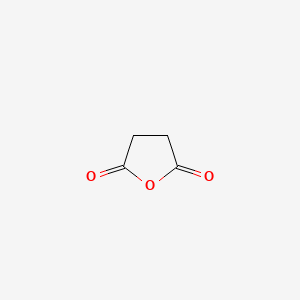
Succinic anhydride
Succinic anhydride is a cyclic dicarboxylic anhydride and a tetrahydrofurandione. It is functionally related to a succinic acid. — ChEBI
- IUPAC-Name
- oxolane-2,5-dione
- Summenformel
- C4H4O3
- Molekulargewicht
- 100.07 g/mol
- Exakte Masse
- 100.016043985 Da
- XLogP3
- -0,5
- Topologische polare Oberfläche
- 43,4 Ų
- Wasserstoffbrücken-Donoren
- 0
- Wasserstoffbrücken-Akzeptoren
- 3
- Kovalente Einheiten
- 1
- Definierte Stereozentren
- 0
Auch bekannt als
16 weitere gemeldete Namen
Kennungen in externen Datenbanken
- ChEBI:CHEBI:36595
- ChEMBL:CHEMBL1370164
- EPA DTXSID:DTXSID7021287
- PubMed:21715091
- PubMed:21581623
- PubMed:18041857
- PubMed:12378641
Belege aus weiteren wissenschaftlichen Datenbanken
NIH PubChem PUG-View
Attributed physical-property, hazard, environmental and use annotations.
- Boiling Point: 502 °F at 760 mmHg (NTP, 1992) Quelle: CAMEO Chemicals
- Boiling Point: 261 °C at 760 mm Hg Quelle: Hazardous Substances Data Bank (HSDB)
- Boiling Point: 261 °C Quelle: ILO-WHO International Chemical Safety Cards (ICSCs)
- Boiling Point: 261 °C @760 [mm Hg] Quelle: PAC Chemical Database, U.S. Department of Energy
- Color/Form: NEEDLES FROM ALC; RHOMBIC PYRAMIDS FROM CHLOROFORM OR CARBON TETRACHLORIDE Quelle: Hazardous Substances Data Bank (HSDB)
- Color/Form: COLORLESS OR LIGHT-COLORED NEEDLES OR FLAKES Quelle: Hazardous Substances Data Bank (HSDB)
- Color/Form: Orthorhombic prisms from abs alc. Quelle: Hazardous Substances Data Bank (HSDB)
- Color/Form: Succinic anhydride forms rhombic pyramidal or bipyramidal crystals. Quelle: Hazardous Substances Data Bank (HSDB)
- Density: 1.234 at 68 °F (NTP, 1992) - Denser than water; will sink Quelle: CAMEO Chemicals
- Density: 1.503 (also given as 1.104 and 1.234) Quelle: Hazardous Substances Data Bank (HSDB)
- Density: Bulk density: 47.2 lb/cu ft Quelle: Hazardous Substances Data Bank (HSDB)
- Density: Relative density (water = 1): 1.503 Quelle: ILO-WHO International Chemical Safety Cards (ICSCs)
- Density: 1.104 @25 °C Quelle: PAC Chemical Database, U.S. Department of Energy
- Flash Point: 157 °C Quelle: Haz-Map, Information on Hazardous Chemicals and Occupational Diseases
- Flash Point: 157 °C Quelle: ILO-WHO International Chemical Safety Cards (ICSCs)
- Melting Point: 247.3 °F (NTP, 1992) Quelle: CAMEO Chemicals
- Melting Point: 119.6 °C Quelle: Hazardous Substances Data Bank (HSDB)
- Melting Point: 119 °C Quelle: Human Metabolome Database (HMDB)
- Melting Point: 119.6 °C Quelle: ILO-WHO International Chemical Safety Cards (ICSCs)
- Melting Point: 119.6 °C Quelle: PAC Chemical Database, U.S. Department of Energy
- Odor: ODORLESS Quelle: Hazardous Substances Data Bank (HSDB)
- Physical Description: Succinic anhydride appears as colorless needles or white crystalline solid. Melting point 237 °F. Sublimes at 239 °F at 5 mmHg pressure; and at 198 °F and 1 mmHg pressure. Moderately toxic and an irritant. Quelle: CAMEO Chemicals
- Physical Description: Other Solid; Dry Powder; Liquid Quelle: EPA Chemical Data Reporting (CDR)
- Physical Description: Colorless or light-colored solid; [Hawley] Odorless; [HSDB] White crystalline solid; [MSDSonline] Quelle: Haz-Map, Information on Hazardous Chemicals and Occupational Diseases
- Physical Description: Solid Quelle: Human Metabolome Database (HMDB)
- Physical Description: COLOURLESS CRYSTALS OR FLAKES. Quelle: ILO-WHO International Chemical Safety Cards (ICSCs)
- Solubility: less than 1 mg/mL at 70 °F (NTP, 1992) Quelle: CAMEO Chemicals
- Solubility: Insoluble in water Quelle: Hazardous Substances Data Bank (HSDB)
- Solubility: IN ETHANOL AT 25 °C: 2.56 G/100 ML; IN ETHER AT 25 °C: 0.64 G/100 ML; IN CHLOROFORM AT 25 °C: 0.87 G/100 ML Quelle: Hazardous Substances Data Bank (HSDB)
- Solubility: Soluble in chloroform, carbon tetrachloride, alcohol; very slightly soluble in ether and water. Quelle: Hazardous Substances Data Bank (HSDB)
- Solubility: Solubility in water: none Quelle: ILO-WHO International Chemical Safety Cards (ICSCs)
- Vapor Pressure: 1 mmHg at 197.6 °F ; 5 mmHg at 239.0 °F; 10 mmHg at 262.8 °F (NTP, 1992) Quelle: CAMEO Chemicals
- Vapor Pressure: 0.0015 [mmHg] Quelle: Haz-Map, Information on Hazardous Chemicals and Occupational Diseases
- Vapor Pressure: Vapor pressure = 1 mm Hg at 92 °C Quelle: Hazardous Substances Data Bank (HSDB)
- Vapor Pressure: 1.5X10⁻³ mm Hg at 25 °C (estrapolated) Quelle: Hazardous Substances Data Bank (HSDB)
- Vapor Pressure: Vapor pressure, kPa at 92 °C: 1.3 Quelle: ILO-WHO International Chemical Safety Cards (ICSCs)
- Vapor Pressure: 1 [mm Hg] @92 °C Quelle: PAC Chemical Database, U.S. Department of Energy
- IARC Carcinogenic Agent: Succinic anhydride Quelle: International Agency for Research on Cancer (IARC)
- IARC Carcinogenic Classes: Group 3: Not classifiable as to its carcinogenicity to humans Quelle: International Agency for Research on Cancer (IARC)
- IARC Monographs: Volume 15: (1977) Some Fumigants, the Herbicides 2,4-D and 2,4,5-T, Chlorinated Dibenzodioxins and Miscellaneous Industrial Chemicals; Volume Sup 7: Overall Evaluations of Carcinogenicity: An Updating of IARC Monographs Volumes 1 to 42, 1987; 440 pages; ISBN 92-832-1411-0 (out of print) Quelle: International Agency for Research on Cancer (IARC)
- Publication Year: 1987 Quelle: International Agency for Research on Cancer (IARC)
- Evaluation Year: 1987 Quelle: International Agency for Research on Cancer (IARC)
- Substance: Succinic Anhydride Quelle: NTP Technical Reports
- NTP Technical Report: TR-373: Toxicology and Carcinogenesis Studies of Succinic Anhydride (CASRN 108-30-5) in F344/N Rats and B6C3F1 Mice (Gavage Studies) (1990 ) Quelle: NTP Technical Reports
- Peer Review Date: 06/27/89 Quelle: NTP Technical Reports
- Conclusion for Male Rat: No Evidence Quelle: NTP Technical Reports
- Conclusion for Female Rat: No Evidence Quelle: NTP Technical Reports
- Conclusion for Male Mice: No Evidence Quelle: NTP Technical Reports
- Conclusion for Female Mice: No Evidence Quelle: NTP Technical Reports
- Exposure Routes: The substance can be absorbed into the body by inhalation and by ingestion. Quelle: ILO-WHO International Chemical Safety Cards (ICSCs)
- First Aid: EYES: First check the victim for contact lenses and remove if present. Flush victim's eyes with water or normal saline solution for 20 to 30 minutes while simultaneously calling a hospital or poison control center. Do not put any ointments, oils, or medication in the victim's eyes without specific instructions from a physician. IMMEDIATELY transport the victim after flushing eyes to a hospital even if no symptoms (such as redness or irritation) develop.; SKIN: IMMEDIATELY flood affected skin with water while removing and isolating all contaminated clothing. Gently wash all affected skin areas thoroughly with soap and water. If symptoms such as redness or irritation develop, IMMEDIATELY call a physician and be prepared to transport the victim to a hospital for treatment.; INHALATION: IMMEDIATELY leave the contaminated area; take deep breaths of fresh air. If symptoms (such as wheezing, coughing, shortness of breath, or burning in the mouth, throat, or chest) develop, call a physician and be prepared to transport the victim to a hospital. Provide proper respiratory protection to rescuers entering an unknown atmosphere. Whenever possible, Self-Contained Breathing Apparatus (SCBA) shou Quelle: CAMEO Chemicals
- Signal: Danger Quelle: Regulation (EC) No 1272/2008 of the European Parliament and of the Council
- GHS Hazard Statements: H302: Harmful if swallowed [Warning Acute toxicity, oral]; H314: Causes severe skin burns and eye damage [Danger Skin corrosion/irritation]; H317: May cause an allergic skin reaction [Warning Sensitization, Skin]; H318: Causes serious eye damage [Danger Serious eye damage/eye irritation]; H334: May cause allergy or asthma symptoms or breathing difficulties if inhaled [Danger Sensitization, respiratory] Quelle: Regulation (EC) No 1272/2008 of the European Parliament and of the Council
- Precautionary Statement Codes: P233, P260, P261, P264, P264+P265, P270, P271, P272, P280, P284, P301+P317, P301+P330+P331, P302+P352, P302+P361+P354, P304+P340, P305+P354+P338, P316, P317, P321, P330, P333+P317, P342+P316, P362+P364, P363, P403, P405, and P501 (click each P-code to see the statement) Quelle: Regulation (EC) No 1272/2008 of the European Parliament and of the Council
- Note: This chemical does not meet GHS hazard criteria for 0.2% (2 of 1275) of reports. Quelle: European Chemicals Agency (ECHA)
- Signal: Danger Quelle: European Chemicals Agency (ECHA)
- GHS Hazard Statements: H302 (98.5%): Harmful if swallowed [Warning Acute toxicity, oral]; H314 (18.8%): Causes severe skin burns and eye damage [Danger Skin corrosion/irritation]; H317 (20.8%): May cause an allergic skin reaction [Warning Sensitization, Skin]; H318 (16.5%): Causes serious eye damage [Danger Serious eye damage/eye irritation]; H319 (81.1%): Causes serious eye irritation [Warning Serious eye damage/eye irritation]; H334 (20.8%): May cause allergy or asthma symptoms or breathing difficulties if inhaled [Danger Sensitization, respiratory]; H335 (90.6%): May cause respiratory irritation [Warning Specific target organ toxicity, single exposure; Respiratory tract irritation] Quelle: European Chemicals Agency (ECHA)
- Precautionary Statement Codes: P233, P260, P261, P264, P264+P265, P270, P271, P272, P280, P284, P301+P317, P301+P330+P331, P302+P352, P302+P361+P354, P304+P340, P305+P351+P338, P305+P354+P338, P316, P317, P319, P321, P330, P333+P317, P337+P317, P342+P316, P362+P364, P363, P403, P403+P233, P405, and P501 (click each P-code to see the statement) Quelle: European Chemicals Agency (ECHA)
- ECHA C&L Notifications Summary: Aggregated GHS information provided per 1275 reports by companies from 39 notifications to the ECHA C&L Inventory. Each notification may be associated with multiple companies.; Reported as not meeting GHS hazard criteria per 2 of 1275 reports by companies.; There are 38 notifications provided by 1273 of 1275 reports by companies with hazard statement code(s).; Information may vary between notifications depending on impurities, additives, and other factors. The percentage value in parenthesis indicates the notified classification ratio from companies that provide hazard codes. Only hazard codes with percentage values above 10% are shown. For more detailed information, please visit ECHA C&L website. Quelle: European Chemicals Agency (ECHA)
- Signal: Warning Quelle: NITE-CMC
- GHS Hazard Statements: H317: May cause an allergic skin reaction [Warning Sensitization, Skin]; H402: Harmful to aquatic life [Hazardous to the aquatic environment, acute hazard]; H412: Harmful to aquatic life with long lasting effects [Hazardous to the aquatic environment, long-term hazard] Quelle: NITE-CMC
- Precautionary Statement Codes: P261, P272, P273, P280, P302+P352, P321, P333+P317, P362+P364, and P501 (click each P-code to see the statement) Quelle: NITE-CMC
- Signal: Danger Quelle: NITE-CMC
- Environmental Bioconcentration: Bioconcentration of succinic anhydride in aquatic organisms is unlikely due its rapid hydrolysis(1). Experimental bioconcentration factors (chemical concentration in fish/chemical concentration in water) of succinic anhydride in fish (Golden ide) were less than 10(2,3). Quelle: Hazardous Substances Data Bank (HSDB)
- Environmental Fate: TERRESTRIAL FATE: The half-life for the hydrolysis of succinic anhydride is 4.3 minutes(SRC), based on a rate constant of 0.0027 1/sec at 25 °C(1). The major fate of succinic anhydride in soil is expected to be hydrolysis (SRC). Succinic anhydride is not expected to volatilize from dry soil surfaces(SRC) based upon a vapor pressure of 1.5X10⁻³ mm Hg(2). Quelle: Hazardous Substances Data Bank (HSDB)
- Environmental Fate: AQUATIC FATE: The half-life for the hydrolysis of succinic anhydride is 4.3 minutes(SRC), based on a rate constant of 0.0027 1/sec at 25 °C(1). The major fate of succinic anhydride in aquatic environments is expected to be hydrolysis(SRC). Bioconcentration of succinic anhydride in aquatic organisms is unlikely due its rapid hydrolysis(SRC). Approximately 78% of the succinic anhydride added to activated sewage sludge was biodegraded within five days(2,3); however, hydrolysis is expected to be the principal fate of succinic anhydride in water(SRC). Quelle: Hazardous Substances Data Bank (HSDB)
- Environmental Fate: ATMOSPHERIC FATE: According to a model of gas/particle partitioning of semivolatile organic compounds in the atmosphere(1), succinic anhydride, which has a vapor pressure of 1.5X10⁻³ mm Hg at 25 °C(2) is expected to exist solely as a vapor in the ambient atmosphere. Vapor-phase succinic anhydride is degraded in the atmosphere by reaction with photochemically-produced hydroxyl radicals(SRC); the half-life for this reaction in air is estimated to be 70 days (SRC), calculated from its rate constant of 4.56X10⁻¹³ cu cm/molecule-sec at 25 °C(SRC) that was derived using a structure estimation method(3). Quelle: Hazardous Substances Data Bank (HSDB)
- Industry Uses: Corrosion inhibitor; Not Known or Reasonably Ascertainable; pH regulating agent; Other Quelle: EPA Chemical Data Reporting (CDR)
- Sources/Uses: Used as an acidulant and dehydrating agent (food processing), cross-linking agent (epoxy resins and ion exchange membranes), and in gas and water treatment; Also used to make adhesives, paint drying oils, dyes, pharmaceuticals, esters, elastomers (cable coverings and extruded articles), hardeners for resins, starch modifiers in foods, succinylated monoglyceride food emulsifiers, silver haloid photographic emulsions, detergents, cosmetics, plant growth regulators, textiles, surface-active agents, lubricant additives, fire-retardants for paper, insect repellants, and herbicides; [HSDB] Quelle: Haz-Map, Information on Hazardous Chemicals and Occupational Diseases
- Industrial Processes with risk of exposure: Textiles (Fiber & Fabric Manufacturing) [Category: Industry]; Sewer and Wastewater Treatment [Category: Industry]; Plastic Composites Manufacturing [Category: Industry] Quelle: Haz-Map, Information on Hazardous Chemicals and Occupational Diseases
- Uses: Acidulant in processed foods Quelle: Hazardous Substances Data Bank (HSDB)
- Uses: Dehydrating agent in dry food mixtures Quelle: Hazardous Substances Data Bank (HSDB)
- Uses: Chemical intermediate for adhesives, dyes; elastomers for special tubings, cable coverings, and extruded articles. Quelle: Hazardous Substances Data Bank (HSDB)
- Uses: Manufacture of chemicals, pharmaceuticals, esters; hardener for resins, starch modifier in foods. Quelle: Hazardous Substances Data Bank (HSDB)
- Uses: For more Uses (Complete) data for SUCCINIC ANHYDRIDE (9 total), please visit the HSDB record page. Quelle: Hazardous Substances Data Bank (HSDB)
Zugeordnet durch: Existing checksum-valid CAS to unique PubChem CID match. Abgerufen: 2026-08-31. Quelleneintrag öffnen
Wissenschaftliche Klassifizierungen und Gefahrenannotationen liefern Kontext und ersetzen nicht die oben gezeigte marktspezifische regulatorische Entscheidung.
Weitere Quellenabdeckung und Trefferstatus
| Quelle | Ergebnis | Geprüft |
|---|---|---|
| NIH PubChem PUG-View | Exakter Treffer | 2026-08-31 |
Ein erfasster Nicht-Treffer ist ein nützlicher Beleg dafür, dass die Quelle geprüft wurde; er ist keine Behauptung, dass der Stoff anderswo nicht existiert.
Am 2026-08-31 von NIH PubChem durch prüfsummengültigen CAS-Abgleich abgerufen. Chemische Eigenschaften ersetzen nicht die regulatorische Entscheidung auf dieser Seite.