CAS 105-87-3PubChem CID 1549026
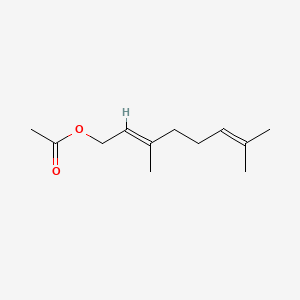
Geranyl Acetate
Geranyl acetate is a clear colorless liquid with an odor of lavender. (NTP, 1992)
— CAMEO Chemicals
- IUPAC-Name
- [(2E)-3,7-dimethylocta-2,6-dienyl] acetate
- Summenformel
- C12H20O2
- Molekulargewicht
- 196.29 g/mol
- Exakte Masse
- 196.146329876 Da
- XLogP3
- 3,5
- Topologische polare Oberfläche
- 26,3 Ų
- Wasserstoffbrücken-Donoren
- 0
- Wasserstoffbrücken-Akzeptoren
- 2
- Kovalente Einheiten
- 1
- Definierte Stereozentren
- 0
Auch bekannt als
Geranyl ethanoateGeranyl acetate AAcetic acid, geraniol estertrans-3,7-Dimethyl-2,6-octadien-1-yl acetatetrans-Geraniol acetate2,6-Octadien-1-ol, 3,7-dimethyl-, acetate, (E)-(E)-3,7-Dimethylocta-2,6-dien-1-yl acetateNCI-C54728
16 weitere gemeldete Namen
trans-geranyl acetate(2E)-3,7-dimethylocta-2,6-dien-1-yl acetateFEMA No. 2509FEMA Number 2509trans-2,6-Dimethyl-2,6-octadien-8-yl ethanoate3,7-Dimethyl-2-trans, 6-octadienyl acetate3W81YG7P9RCHEBI:53313,7-Dimethyl-2,6-octadien-1-ol acetate2,6-Dimethyl-2,6-octadiene-8-yl acetate1-Octanol, 3,7-dimethyl-, acetate, tetradehydro deriv.NSC-2584trans-3,7-Dimethyl-2,6-octadien-1-ol, acetate2,6-Octadien-1-ol, 3,7-dimethyl-, acetate, trans-2,6-Octadien-1-ol, 3,7-dimethyl-, acetate, (2E)-((2E)-3,7-dimethylocta-2,6-dienyl) acetate
Kennungen in externen Datenbanken
Belege aus weiteren wissenschaftlichen Datenbanken
EMBL-EBI ChEBI
Exakter KennungstrefferCHEBI:5331
geranyl acetate
A monoterpenoid that is the acetate ester derivative of geraniol.
- Rezeptur
- C12H20O2
- Durchschnittsmasse
- 196.290 g/mol
- Monoisotopische Masse
- 196.14633 Da
- Formale Ladung
- 0
-
acetate ester
— is a (CHEBI:47622)
-
monoterpenoid
— is a (CHEBI:25409)
-
plant metabolite
— has role (CHEBI:76924)
-
geraniol
— has functional parent (CHEBI:17447)
-
plant metabolite
— has role (CHEBI:76924)
-
acetate ester
— is a (CHEBI:47622)
-
monoterpenoid
— is a (CHEBI:25409)
Weitere kuratierte Namen
(2E)-3,7-dimethylocta-2,6-dien-1-yl acetatetrans-3,7-dimethyl-2,6-octadien-1-yl acetate
Querverweise aus dieser Quelle
Zugeordnet durch: Exact CAS cross-reference in the ChEBI compound record.
Quelle aktualisiert: 2020-10-28.
Abgerufen: 2026-08-31.
Quelleneintrag öffnen
NIH PubChem PUG-View
Exakter Kennungstreffer1549026
Attributed physical-property, hazard, environmental and use annotations.
- Substance:
Geranyl acetate
Quelle: NTP Technical Reports
- NTP Technical Report:
TR-252: Carcinogenesis Studies of Food Grade Geranyl Acetate (71% Geranyl Acetate, 29% Citronellyl Acetate) (CASRN 105-87-3) in F344/N Rats and B6C3F1 Mice (Gavage Study) (1987 )
Quelle: NTP Technical Reports
- Peer Review Date:
09/22/82
Quelle: NTP Technical Reports
- Conclusion for Male Rat:
No Evidence
Quelle: NTP Technical Reports
- Conclusion for Female Rat:
No Evidence
Quelle: NTP Technical Reports
- Conclusion for Male Mice:
No Evidence
Quelle: NTP Technical Reports
- Conclusion for Female Mice:
No Evidence
Quelle: NTP Technical Reports
- Summary:
Under the conditions of these studies, geranyl acetate was not carcinogenic for F344/N rats or B6C3F1 mice of either sex; however, the reduced survival observed in high dose male rats, high dose male mice, and high and low dose female mice lowered the sensitivity of these studies for detecting neoplastic responses in these groups. In male rats the marginal increases of squamous cell papillomas of the skin and tubular cell adenomas of the kidney may have been related to administration of geranyl acetate.
Quelle: NTP Technical Reports
- Carcinogen Classification:
No indication of carcinogenicity to humans (not listed by IARC).
Quelle: Toxin and Toxin Target Database (T3DB)
- First Aid:
EYES: First check the victim for contact lenses and remove if present. Flush victim's eyes with water or normal saline solution for 20 to 30 minutes while simultaneously calling a hospital or poison control center. Do not put any ointments, oils, or medication in the victim's eyes without specific instructions from a physician. IMMEDIATELY transport the victim after flushing eyes to a hospital even if no symptoms (such as redness or irritation) develop.; SKIN: IMMEDIATELY flood affected skin with water while removing and isolating all contaminated clothing. Gently wash all affected skin areas thoroughly with soap and water. If symptoms such as redness or irritation develop, IMMEDIATELY call a physician and be prepared to transport the victim to a hospital for treatment.; INHALATION: IMMEDIATELY leave the contaminated area; take deep breaths of fresh air. If symptoms (such as wheezing, coughing, shortness of breath, or burning in the mouth, throat, or chest) develop, call a physician and be prepared to transport the victim to a hospital. Provide proper respiratory protection to rescuers entering an unknown atmosphere. Whenever possible, Self-Contained Breathing Apparatus (SCBA) shou
Quelle: CAMEO Chemicals
- Signal:
Warning
Quelle: European Chemicals Agency (ECHA)
- GHS Hazard Statements:
H315 (79.8%): Causes skin irritation [Warning Skin corrosion/irritation]; H317 (77.6%): May cause an allergic skin reaction [Warning Sensitization, Skin]; H411 (20.5%): Toxic to aquatic life with long lasting effects [Hazardous to the aquatic environment, long-term hazard]; H412 (77.2%): Harmful to aquatic life with long lasting effects [Hazardous to the aquatic environment, long-term hazard]
Quelle: European Chemicals Agency (ECHA)
- Precautionary Statement Codes:
P261, P264, P272, P273, P280, P302+P352, P321, P332+P317, P333+P317, P362+P364, P391, and P501 (click each P-code to see the statement)
Quelle: European Chemicals Agency (ECHA)
- ECHA C&L Notifications Summary:
Aggregated GHS information provided per 2195 reports by companies from 24 notifications to the ECHA C&L Inventory. Each notification may be associated with multiple companies.; Information may vary between notifications depending on impurities, additives, and other factors. The percentage value in parenthesis indicates the notified classification ratio from companies that provide hazard codes. Only hazard codes with percentage values above 10% are shown. For more detailed information, please visit ECHA C&L website.
Quelle: European Chemicals Agency (ECHA)
- GHS Hazard Statements:
Not Classified
Quelle: NITE-CMC
- Environmental Bioconcentration:
An estimated BCF of 260 was calculated in fish for geranyl acetate(SRC), using a log Kow of 4.04(1) and a regression-derived equation(2). According to a classification scheme(3), this BCF suggests the potential for bioconcentration in aquatic organisms is high, provided the compound is not metabolized by the organism(SRC).
Quelle: Hazardous Substances Data Bank (HSDB)
- Environmental Fate:
TERRESTRIAL FATE: Based on a classification scheme(1), an estimated Koc value of 3,700(SRC), determined from a log Kow of 4.04(2) and a regression-derived equation(3), indicates that geranyl acetate is expected to have slight mobility in soil(SRC). Volatilization of geranyl acetate from moist soil surfaces is expected to be an important fate process(SRC) given an estimated Henry's Law constant of 2.4X10⁻³ atm-cu m/mole(SRC), using a fragment constant estimation method(4). However, adsorption to soil is expected to attenuate volatilization(SRC). Geranyl acetate is not expected to volatilize from dry soil surfaces(SRC) based upon an estimated vapor pressure of 3.3X10⁻² mm Hg(5). Biodegradation data were not available(SRC, 2007).
Quelle: Hazardous Substances Data Bank (HSDB)
- Environmental Fate:
AQUATIC FATE: Based on a classification scheme(1), an estimated Koc value of 3,700(SRC), determined from a log Kow of 4.04(2) and a regression-derived equation(3), indicates that geranyl acetate is expected to adsorb to suspended solids and sediment(SRC). Volatilization from water surfaces is expected(3) based upon an estimated Henry's Law constant of 2.4X10⁻³ atm-cu m/mole(SRC), developed using a fragment constant estimation method(4). Using this Henry's Law constant and an estimation method(3), volatilization half-lives for a model river and model lake are 7.4 hours and 6.5 days, respectively(SRC). However, volatilization from water surfaces is expected to be attenuated by adsorption to suspended solids and sediment in the water column. The estimated volatilization half-life from a model pond is 30 days if adsorption is considered(5). According to a classification scheme(6), an estimated BCF of 260(SRC), from its log Kow(2) and a regression-derived equation(7), suggests the potential for bioconcentration in aquatic organisms is high, provided the compound is not metabolized by the organism(SRC). Biodegradation data were not available(SRC, 2007).
Quelle: Hazardous Substances Data Bank (HSDB)
- Environmental Fate:
ATMOSPHERIC FATE: According to a model of gas/particle partitioning of semivolatile organic compounds in the atmosphere(1), geranyl acetate, which has an estimated vapor pressure of 3.3X10⁻² mm Hg at 25 °C(2), is expected to exist solely as a vapor in the ambient atmosphere. Vapor-phase geranyl acetate is degraded in the atmosphere by reaction with photochemically-produced hydroxyl radicals(SRC); the half-life for this reaction in air is estimated to be 2 hrs(SRC), calculated from its rate constant of 1.8X10⁻¹⁰ cu cm/molecule-sec at 25 °C(SRC) that was derived using a structure estimation method(3). The rate constant for the vapor-phase reaction of geranyl acetate with ozone has been estimated as 8.60X10⁻¹⁶ cu cm/molecule-sec at 25 °C(SRC) that was derived using a structure estimation method(3). This corresponds to an atmospheric half-life of about 19 minutes(4). Geranyl acetate does contain chromophores that absorb at wavelengths >290 nm and therefore may be susceptible to direct photolysis by sunlight(5).
Quelle: Hazardous Substances Data Bank (HSDB)
- Sources/Uses:
Occurs in several essential oils; Used in perfumes and flavors; [Hawley]
Quelle: Haz-Map, Information on Hazardous Chemicals and Occupational Diseases
- Uses:
Perfumery, flavoring
Quelle: Hazardous Substances Data Bank (HSDB)
- Uses:
Used as a synthetic flavoring substance and adjuvant.
Quelle: Hazardous Substances Data Bank (HSDB)
- Uses:
Used frequently in perfumery to create not only flowery-fruity nuances (example, rose), but also for citrus and lavender notes. A small amount is added to fruit aromas for shading.
Quelle: Hazardous Substances Data Bank (HSDB)
- Uses:
Widely used in perfume compositions as a sweetener and modifier in floral, fruit, herbaceous and Citrusy fragrance types. Used in flavor composition for a great variation of types: apricot, apple, banana, blackcurrant, gooseberry, ginger ale, grape, honey, lemon, peach, pear, lime, wine, and in various spice complexes, berry variations, and floral flavor types.
Quelle: Hazardous Substances Data Bank (HSDB)
- Uses:
Reported uses: Alcoholic and nonalcoholic beverages; baked goods, chewing gum, frozen dairy, gelatin (pudding), gravies, hard and soft candy, meat products.
Quelle: Hazardous Substances Data Bank (HSDB)
Zugeordnet durch: Existing checksum-valid CAS to unique PubChem CID match.
Abgerufen: 2026-08-31.
Quelleneintrag öffnen
Wissenschaftliche Klassifizierungen und Gefahrenannotationen liefern Kontext und ersetzen nicht die oben gezeigte marktspezifische regulatorische Entscheidung.
Weitere Quellenabdeckung und Trefferstatus
| Quelle | Ergebnis | Geprüft |
|---|
| EMBL-EBI ChEBI | Exakter Treffer | 2026-08-31 |
|---|
| NIH PubChem PUG-View | Exakter Treffer | 2026-08-31 |
|---|
Ein erfasster Nicht-Treffer ist ein nützlicher Beleg dafür, dass die Quelle geprüft wurde; er ist keine Behauptung, dass der Stoff anderswo nicht existiert.
Am 2026-09-02 von NIH PubChem durch prüfsummengültigen CAS-Abgleich abgerufen. Chemische Eigenschaften ersetzen nicht die regulatorische Entscheidung auf dieser Seite.