
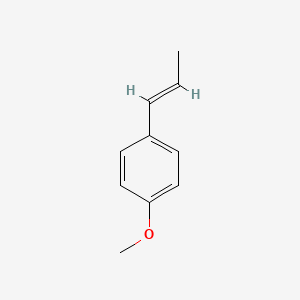
Anethole
Anethole is a monomethoxybenzene that is methoxybenzene substituted by a prop-1-en-1-yl group at position 4. It has a role as a plant metabolite. — ChEBI
- IUPAC-Name
- 1-methoxy-4-[(E)-prop-1-enyl]benzene
- Summenformel
- C10H12O
- Molekulargewicht
- 148.20 g/mol
- Exakte Masse
- 148.088815002 Da
- XLogP3
- 3,3
- Topologische polare Oberfläche
- 9,2 Ų
- Wasserstoffbrücken-Donoren
- 0
- Wasserstoffbrücken-Akzeptoren
- 1
- Kovalente Einheiten
- 1
- Definierte Stereozentren
- 0
Auch bekannt als
16 weitere gemeldete Namen
Kennungen in externen Datenbanken
- ChEBI:CHEBI:2716
- ChEBI:CHEBI:35616
- ChEMBL:CHEMBL452630
- EPA DTXSID:DTXSID9020087
- PubMed:40796067
- PubMed:39029857
- PubMed:37987213
- PubMed:35430261
- PubMed:29191726
- PubMed:27420082
- PubMed:26795242
- PubMed:22317828
- PubMed:21212515
- PubMed:20171274
- PubMed:17709257
- PubMed:16573833
Belege aus weiteren wissenschaftlichen Datenbanken
NIH PubChem PUG-View
Attributed physical-property, hazard, environmental and use annotations.
- Boiling Point: 454.1 °F at 760 mmHg (NTP, 1992) Quelle: CAMEO Chemicals
- Boiling Point: 234 °C Quelle: Hazardous Substances Data Bank (HSDB)
- Boiling Point: 234-239.5 °C Quelle: Joint FAO/WHO Expert Committee on Food Additives (JECFA)
- Color/Form: White crystals Quelle: Hazardous Substances Data Bank (HSDB)
- Density: 0.9882 (NTP, 1992) - Less dense than water; will float Quelle: CAMEO Chemicals
- Density: 0.9878 @ 20 °C/4 °C Quelle: Hazardous Substances Data Bank (HSDB)
- Density: 0.983-0.988 Quelle: Joint FAO/WHO Expert Committee on Food Additives (JECFA)
- Flash Point: 195 °F (NTP, 1992) Quelle: CAMEO Chemicals
- Flash Point: 90.1 °C Quelle: Haz-Map, Information on Hazardous Chemicals and Occupational Diseases
- Melting Point: 70.4 °F (NTP, 1992) Quelle: CAMEO Chemicals
- Melting Point: 21.3 °C Quelle: Hazardous Substances Data Bank (HSDB)
- Melting Point: Liquid Molar Volume = 0.1507 cu m/kmol; Heat of Fusion @ Melting Point = 1.60E+7 J/kmol Quelle: Hazardous Substances Data Bank (HSDB)
- Odor: ANISE OIL ODOR Quelle: Hazardous Substances Data Bank (HSDB)
- Physical Description: Anethole appears as white crystals or a liquid. Odor of anise oil and a sweet taste. (NTP, 1992) Quelle: CAMEO Chemicals
- Physical Description: Liquid Quelle: EPA Chemical Data Reporting (CDR)
- Physical Description: Liquid; CBI Quelle: EPA Chemical Data Reporting (CDR)
- Physical Description: White solid with an odor of anise; Affected by light; [Hawley] Colorless liquid with a sweet odor of aniseed; [Merck Index] Colorless crystalline solid or liquid; mp = 20-23 deg C; [MSDSonline] Quelle: Haz-Map, Information on Hazardous Chemicals and Occupational Diseases
- Physical Description: Colourless to faintly yellow liquid with an aniseed-like odour Quelle: Joint FAO/WHO Expert Committee on Food Additives (JECFA)
- Refractive Index: 1.559-1.562 Quelle: Joint FAO/WHO Expert Committee on Food Additives (JECFA)
- Solubility: Slightly soluble (NTP, 1992) Quelle: CAMEO Chemicals
- Solubility: 1:8 IN 80% ALCOHOL; 1:1 IN 90% ETHANOL Quelle: Hazardous Substances Data Bank (HSDB)
- Solubility: ALMOST WATER INSOL; MISCIBLE WITH CHLOROFORM & ETHER Quelle: Hazardous Substances Data Bank (HSDB)
- Solubility: Water solubility = 1.110E-1 g/l @ 25 °C Quelle: Hazardous Substances Data Bank (HSDB)
- Solubility: Slightly soluble in water; miscible with chloroform and ether Quelle: Joint FAO/WHO Expert Committee on Food Additives (JECFA)
- Solubility: 1 ml in 2 ml 96% alcohol (in ethanol) Quelle: Joint FAO/WHO Expert Committee on Food Additives (JECFA)
- Vapor Pressure: 0.05 [mmHg] Quelle: Haz-Map, Information on Hazardous Chemicals and Occupational Diseases
- Vapor Pressure: 5.45 Pa @ 294 deg K Quelle: Hazardous Substances Data Bank (HSDB)
- Viscosity: 2.45X10⁻³ Pa.s Quelle: Hazardous Substances Data Bank (HSDB)
- First Aid: EYES: First check the victim for contact lenses and remove if present. Flush victim's eyes with water or normal saline solution for 20 to 30 minutes while simultaneously calling a hospital or poison control center. Do not put any ointments, oils, or medication in the victim's eyes without specific instructions from a physician. IMMEDIATELY transport the victim after flushing eyes to a hospital even if no symptoms (such as redness or irritation) develop.; SKIN: IMMEDIATELY flood affected skin with water while removing and isolating all contaminated clothing. Gently wash all affected skin areas thoroughly with soap and water. If symptoms such as redness or irritation develop, IMMEDIATELY call a physician and be prepared to transport the victim to a hospital for treatment.; INHALATION: IMMEDIATELY leave the contaminated area; take deep breaths of fresh air. If symptoms (such as wheezing, coughing, shortness of breath, or burning in the mouth, throat, or chest) develop, call a physician and be prepared to transport the victim to a hospital. Provide proper respiratory protection to rescuers entering an unknown atmosphere. Whenever possible, Self-Contained Breathing Apparatus (SCBA) shou Quelle: CAMEO Chemicals
- Note: This chemical does not meet GHS hazard criteria for 2.9% (55 of 1880) of reports. Quelle: European Chemicals Agency (ECHA)
- Signal: Warning Quelle: European Chemicals Agency (ECHA)
- GHS Hazard Statements: H317 (95.3%): May cause an allergic skin reaction [Warning Sensitization, Skin] Quelle: European Chemicals Agency (ECHA)
- Precautionary Statement Codes: P261, P272, P280, P302+P352, P321, P333+P317, P362+P364, and P501 (click each P-code to see the statement) Quelle: European Chemicals Agency (ECHA)
- ECHA C&L Notifications Summary: Aggregated GHS information provided per 1880 reports by companies from 19 notifications to the ECHA C&L Inventory.; Reported as not meeting GHS hazard criteria per 55 of 1880 reports by companies.; There are 18 notifications provided by 1825 of 1880 reports by companies with hazard statement code(s).; Information may vary between notifications depending on impurities, additives, and other factors. The percentage value in parenthesis indicates the notified classification ratio from companies that provide hazard codes. Only hazard codes with percentage values above 10% are shown. For more detailed information, please visit ECHA C&L website. Quelle: European Chemicals Agency (ECHA)
- Note: This chemical does not meet GHS hazard criteria for 6.2% (20 of 321) of reports. Quelle: European Chemicals Agency (ECHA)
- GHS Hazard Statements: H317 (93.8%): May cause an allergic skin reaction [Warning Sensitization, Skin]; H412 (36.4%): Harmful to aquatic life with long lasting effects [Hazardous to the aquatic environment, long-term hazard] Quelle: European Chemicals Agency (ECHA)
- Precautionary Statement Codes: P261, P272, P273, P280, P302+P352, P321, P333+P317, P362+P364, and P501 (click each P-code to see the statement) Quelle: European Chemicals Agency (ECHA)
- ECHA C&L Notifications Summary: Aggregated GHS information provided per 321 reports by companies from 5 notifications to the ECHA C&L Inventory. Each notification may be associated with multiple companies.; Reported as not meeting GHS hazard criteria per 20 of 321 reports by companies.; There are 4 notifications provided by 301 of 321 reports by companies with hazard statement code(s).; Information may vary between notifications depending on impurities, additives, and other factors. The percentage value in parenthesis indicates the notified classification ratio from companies that provide hazard codes. Only hazard codes with percentage values above 10% are shown. For more detailed information, please visit ECHA C&L website. Quelle: European Chemicals Agency (ECHA)
- Signal: Warning Quelle: Hazardous Chemical Information System (HCIS), Safe Work Australia
- GHS Hazard Statements: H317: May cause an allergic skin reaction [Warning Sensitization, Skin] Quelle: Hazardous Chemical Information System (HCIS), Safe Work Australia
- Precautionary Statement Codes: P261, P272, P280, P302+P352, P321, P333+P317, P362+P364, and P501 (click each P-code to see the statement) Quelle: Hazardous Chemical Information System (HCIS), Safe Work Australia
- Environmental Bioconcentration: Based upon an experimental water solubility of 111 mg/l(1), the BCF of anethole can be estimated to be approximately 43.4 from a regression-derived equation(2). This estimated BCF value suggests that bioconcentration in aquatic organisms is not expected to be an important fate process(SRC). Quelle: Hazardous Substances Data Bank (HSDB)
- Environmental Fate: TERRESTRIAL FATE: Anethole will have a medium to low mobility(3) in soil based on estimated Koc values ranging from 327 to 680(1,2). Insufficient data are available to predict the relative importance or rate of biodegradation in soil conditions(SRC). Quelle: Hazardous Substances Data Bank (HSDB)
- Environmental Fate: AQUATIC FATE: Volatilization of anethole from water is not rapid but could possibly be significant based upon estimated Henry's Law constant of 7.18X10⁻⁵ atm cu m/mol(1,2,SRC). Volatilization half-lives from a model river (1 m deep flowing 1 m/sec with a wind velocity of 3 m/sec) and a model lake (1 meter deep) can be estimated to be about 18 hours and 9 days respectively(2). Insufficient data are available to predict the relative importance or rate of biodegradation from natural waters(SRC). Aquatic bioconcentration is not expected to be an important fate process, however, based on a Koc value of 680(3), some absorption to sediment may occur(SRC). Quelle: Hazardous Substances Data Bank (HSDB)
- Environmental Fate: ATMOSPHERIC FATE: Based on an extrapolated vapor pressure of approximately 0.005 mm Hg at 25 °C(1), anethole will exist in the atmosphere in the vapor phase(2). It will degrade in the atmosphere by reaction with photochemically produced hydroxyl radicals with estimated half-lives of 4.9 and 4.5 hrs for the cis and trans isomers, respectively(3). Anethole will also degrade in the atmosphere by reaction with atmospheric ozone with estimated half-lives of 4.03 and 2.02 hrs for the cis and trans isomers, respectively(3). Quelle: Hazardous Substances Data Bank (HSDB)
- Consumer Uses: Fragrance Quelle: EPA Chemical Data Reporting (CDR)
- Industry Uses: Intermediate Quelle: EPA Chemical Data Reporting (CDR)
- Industry Uses: Other; Intermediates; Fragrance Quelle: EPA Chemical Data Reporting (CDR)
- Sources/Uses: Chief constituent of anise, star anise, and fennel oils; Used as a flavoring agent (foods, beverages, and drugs) and fragrance (soaps and dentifrices); [Merck Index] Used to make anisaldehyde, as a sensitizer in bleaching colors in photography, an embedding material in microscopy, and an insect attractant; [HSDB] Quelle: Haz-Map, Information on Hazardous Chemicals and Occupational Diseases
- Industrial Processes with risk of exposure: Photographic Processing [Category: Other] Quelle: Haz-Map, Information on Hazardous Chemicals and Occupational Diseases
- Uses: The active ingredient is no longer contained in any registered pesticide products ... "cancelled." Quelle: Hazardous Substances Data Bank (HSDB)
- Uses: MFR ANISALDEHYDE; IN PERFUMERY, SOAP & DENTIFRICES; SENSITIZER IN BLEACHING COLORS IN COLOR PHOTOGRAPHY; AS EMBEDDING MATERIAL IN MICROSCOPY; PHARMACEUTIC AID (FLAVOR); VET: HAS BEEN USED AS A CARMINATIVE & AS A FLAVORING AGENT Quelle: Hazardous Substances Data Bank (HSDB)
- Uses: AS FLAVOR INGREDIENT Quelle: Hazardous Substances Data Bank (HSDB)
- Uses: IN LICORICE CANDIES Quelle: Hazardous Substances Data Bank (HSDB)
- Uses: For more Uses (Complete) data for ANETHOLE (6 total), please visit the HSDB record page. Quelle: Hazardous Substances Data Bank (HSDB)
- Uses: Use (kg; approx.) in Germany (2009): >25; Consumption (g per capita; approx.) in Germany (2009): 0.000305; Calculated removal (%): 96.6 Quelle: NORMAN Suspect List Exchange
Zugeordnet durch: Existing checksum-valid CAS to unique PubChem CID match. Abgerufen: 2026-08-31. Quelleneintrag öffnen
Wissenschaftliche Klassifizierungen und Gefahrenannotationen liefern Kontext und ersetzen nicht die oben gezeigte marktspezifische regulatorische Entscheidung.
Weitere Quellenabdeckung und Trefferstatus
| Quelle | Ergebnis | Geprüft |
|---|---|---|
| EMBL-EBI ChEBI | Prüfung erforderlich | 2026-08-31 |
| NIH PubChem PUG-View | Exakter Treffer | 2026-08-31 |
Ein erfasster Nicht-Treffer ist ein nützlicher Beleg dafür, dass die Quelle geprüft wurde; er ist keine Behauptung, dass der Stoff anderswo nicht existiert.
Am 2026-09-02 von NIH PubChem durch prüfsummengültigen CAS-Abgleich abgerufen. Chemische Eigenschaften ersetzen nicht die regulatorische Entscheidung auf dieser Seite.