
CAS
1 Eintrag
CAS 102-06-7
CAS 102-06-7 entspricht 1 EU-Anhangseintrag in den Anhängen II–VI der Verordnung (EG) Nr. 1223/2009.
Einträge zu CAS 102-06-7
1 insgesamtChemische Identität und Eigenschaften
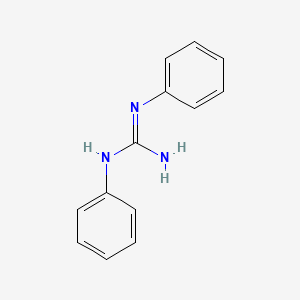
CAS 102-06-7PubChem CID 7594
Diphenylguanidine
1,3-diphenylguanidine is guanidine carrying a phenyl substituent on each of the two amino groups. It is used as an accelerator in the rubber industry. It has a role as an allergen. — ChEBI
- IUPAC-Name
- 1,2-diphenylguanidine
- Summenformel
- C13H13N3
- Molekulargewicht
- 211.26 g/mol
- Exakte Masse
- 211.110947427 Da
- XLogP3
- 2,4
- Topologische polare Oberfläche
- 50,4 Ų
- Wasserstoffbrücken-Donoren
- 2
- Wasserstoffbrücken-Akzeptoren
- 1
- Kovalente Einheiten
- 1
- Definierte Stereozentren
- 0
Auch bekannt als
1,3-DiphenylguanidineN,N'-DIPHENYLGUANIDINEVulkazitMelanilineAccelerator DNocceler DDenaxs-Diphenylguanidine
16 weitere gemeldete Namen
Vulkacite DVulcafor DPGVulkacit DDenax DPGDPG acceleratorVulkacit D/CDwufenyloguanidynaSoxinol DGuanidine, 1,3-diphenyl-Guanidine, N,N'-diphenyl-USAF EK-1270Sanceler DUSAF B-19Vulcacid DNCI-C609246MRZ85RNHQ
Kennungen in externen Datenbanken
- ChEBI:CHEBI:144319
- ChEMBL:CHEMBL77675
- EPA DTXSID:DTXSID3025178
- PubMed:22998617
- PubMed:22762249
- PubMed:21365105
- PubMed:20855699
- PubMed:20646676
- PubMed:20137737
- PubMed:19345756
- PubMed:19220004
- PubMed:18376821
- PubMed:17928183
- PubMed:16426298
- PubMed:15840103
Belege aus weiteren wissenschaftlichen Datenbanken
EMBL-EBI ChEBI
Exakter KennungstrefferCHEBI:144319
1,3-diphenylguanidine
Guanidine carrying a phenyl substituent on each of the two amino groups. It is used as an accelerator in the rubber industry.
- Rezeptur
- C13H13N3
- Durchschnittsmasse
- 211.268 g/mol
- Monoisotopische Masse
- 211.11095 Da
- Formale Ladung
- 0
- guanidines — is a (CHEBI:24436)
- allergen — has role (CHEBI:50904)
- allergen — has role (CHEBI:50904)
- guanidines — is a (CHEBI:24436)
Weitere kuratierte Namen
N,N'-diphenylguanidine1,3-Diphenylguanidines-Diphenylguanidine
Querverweise aus dieser Quelle
- CAS: 102-06-7 — ChemIDplus
Zugeordnet durch: Exact CAS cross-reference in the ChEBI compound record. Quelle aktualisiert: 2019-07-25. Abgerufen: 2026-08-31. Quelleneintrag öffnen
NIH PubChem PUG-View
Exakter Kennungstreffer7594
Attributed physical-property, hazard, environmental and use annotations.
- Boiling Point: Decomposes >338 °F (NTP, 1992) Quelle: CAMEO Chemicals
- Boiling Point: 170 °C (decomposes) Quelle: Hazardous Substances Data Bank (HSDB)
- Color/Form: Monoclinic needles (crystalized from alcohol and toluene) Quelle: Hazardous Substances Data Bank (HSDB)
- Color/Form: White powder Quelle: Hazardous Substances Data Bank (HSDB)
- Density: 1.13 at 68 °F (NTP, 1992) - Denser than water; will sink Quelle: CAMEO Chemicals
- Density: 1.13 g/cu cm at 20 °C Quelle: Hazardous Substances Data Bank (HSDB)
- Density: 1.19 g/cm³ Quelle: ILO-WHO International Chemical Safety Cards (ICSCs)
- Density: 1.13 @ 20°C Quelle: PAC Chemical Database, U.S. Department of Energy
- Dissociation Constants: pKa = 10.12 (conjugate acid) Quelle: Hazardous Substances Data Bank (HSDB)
- Flash Point: 388 °F (NTP, 1992) Quelle: CAMEO Chemicals
- Flash Point: 170 °C Quelle: ILO-WHO International Chemical Safety Cards (ICSCs)
- LogP: log Kow = 2.89 /Estimated/ Quelle: Hazardous Substances Data Bank (HSDB)
- LogP: 1.69 Quelle: ILO-WHO International Chemical Safety Cards (ICSCs)
- Melting Point: 302 °F (NTP, 1992) Quelle: CAMEO Chemicals
- Melting Point: 150 °C Quelle: Hazardous Substances Data Bank (HSDB)
- Melting Point: 150 °C Quelle: ILO-WHO International Chemical Safety Cards (ICSCs)
- Melting Point: 150 °C Quelle: PAC Chemical Database, U.S. Department of Energy
- Odor: Slight odor Quelle: Hazardous Substances Data Bank (HSDB)
- Physical Description: 1,3-diphenylguanidine is a white to cream-colored chalky powder. Bitter taste and slight odor. Quelle: CAMEO Chemicals
- Physical Description: Dry Powder; Large Crystals; Dry Powder; Other Solid; Dry Powder; Large Crystals Quelle: EPA Chemical Data Reporting (CDR)
- Physical Description: Colorless or white solid; [ICSC] White powder; [MSDSonline] Quelle: Haz-Map, Information on Hazardous Chemicals and Occupational Diseases
- Physical Description: COLOURLESS OR WHITE CRYSTALLINE POWDER OR NEEDLES Quelle: ILO-WHO International Chemical Safety Cards (ICSCs)
- Solubility: less than 1 mg/mL at 70 °F (NTP, 1992) Quelle: CAMEO Chemicals
- Solubility: Soluble in ethanol, carbon tetrachloride, chloroform, toluene; very soluble in ethyl ether. Quelle: Hazardous Substances Data Bank (HSDB)
- Solubility: In water, 1,000 mg/L at 25 °C Quelle: Hazardous Substances Data Bank (HSDB)
- Solubility: Solubility in water at 20 °C: poor Quelle: ILO-WHO International Chemical Safety Cards (ICSCs)
- Solubility: 29.5 [ug/mL] (The mean of the results at pH 7.4) Quelle: Sanford-Burnham Center for Chemical Genomics
- Vapor Pressure: Negligible (NTP, 1992) Quelle: CAMEO Chemicals
- Vapor Pressure: 0.00000845 [mmHg] Quelle: Haz-Map, Information on Hazardous Chemicals and Occupational Diseases
- Vapor Pressure: 4.0X10⁻⁶ mm Hg at 25 °C /Estimated/ Quelle: Hazardous Substances Data Bank (HSDB)
- Vapor Pressure: Vapor pressure, kPa at 20 °C: 0.17 Quelle: ILO-WHO International Chemical Safety Cards (ICSCs)
- pH: Aq soln is strongly alkaline Quelle: Hazardous Substances Data Bank (HSDB)
- Exposure Routes: The substance can be absorbed into the body by inhalation and by ingestion. Quelle: ILO-WHO International Chemical Safety Cards (ICSCs)
- First Aid: EYES: First check the victim for contact lenses and remove if present. Flush victim's eyes with water or normal saline solution for 20 to 30 minutes while simultaneously calling a hospital or poison control center. Do not put any ointments, oils, or medication in the victim's eyes without specific instructions from a physician. IMMEDIATELY transport the victim after flushing eyes to a hospital even if no symptoms (such as redness or irritation) develop.; SKIN: IMMEDIATELY flood affected skin with water while removing and isolating all contaminated clothing. Gently wash all affected skin areas thoroughly with soap and water. If symptoms such as redness or irritation develop, IMMEDIATELY call a physician and be prepared to transport the victim to a hospital for treatment.; INHALATION: IMMEDIATELY leave the contaminated area; take deep breaths of fresh air. If symptoms (such as wheezing, coughing, shortness of breath, or burning in the mouth, throat, or chest) develop, call a physician and be prepared to transport the victim to a hospital. Provide proper respiratory protection to rescuers entering an unknown atmosphere. Whenever possible, Self-Contained Breathing Apparatus (SCBA) shou Quelle: CAMEO Chemicals
- Signal: Warning Quelle: Regulation (EC) No 1272/2008 of the European Parliament and of the Council
- GHS Hazard Statements: H302: Harmful if swallowed [Warning Acute toxicity, oral]; H315: Causes skin irritation [Warning Skin corrosion/irritation]; H319: Causes serious eye irritation [Warning Serious eye damage/eye irritation]; H335: May cause respiratory irritation [Warning Specific target organ toxicity, single exposure; Respiratory tract irritation]; H361f ***: Suspected of damaging fertility [Warning Reproductive toxicity]; H411: Toxic to aquatic life with long lasting effects [Hazardous to the aquatic environment, long-term hazard] Quelle: Regulation (EC) No 1272/2008 of the European Parliament and of the Council
- Precautionary Statement Codes: P203, P261, P264, P264+P265, P270, P271, P273, P280, P301+P317, P302+P352, P304+P340, P305+P351+P338, P318, P319, P321, P330, P332+P317, P337+P317, P362+P364, P391, P403+P233, P405, and P501 (click each P-code to see the statement) Quelle: Regulation (EC) No 1272/2008 of the European Parliament and of the Council
- Signal: Danger Quelle: European Chemicals Agency (ECHA)
- GHS Hazard Statements: H301 (34%): Toxic if swallowed [Danger Acute toxicity, oral]; H302 (66%): Harmful if swallowed [Warning Acute toxicity, oral]; H315 (100%): Causes skin irritation [Warning Skin corrosion/irritation]; H319 (98.2%): Causes serious eye irritation [Warning Serious eye damage/eye irritation]; H335 (99.8%): May cause respiratory irritation [Warning Specific target organ toxicity, single exposure; Respiratory tract irritation]; H361 (70.8%): Suspected of damaging fertility or the unborn child [Warning Reproductive toxicity]; H361f (29.2%): Suspected of damaging fertility [Warning Reproductive toxicity]; H411 (100%): Toxic to aquatic life with long lasting effects [Hazardous to the aquatic environment, long-term hazard] Quelle: European Chemicals Agency (ECHA)
- Precautionary Statement Codes: P203, P261, P264, P264+P265, P270, P271, P273, P280, P301+P316, P301+P317, P302+P352, P304+P340, P305+P351+P338, P318, P319, P321, P330, P332+P317, P337+P317, P362+P364, P391, P403+P233, P405, and P501 (click each P-code to see the statement) Quelle: European Chemicals Agency (ECHA)
- ECHA C&L Notifications Summary: Aggregated GHS information provided per 562 reports by companies from 24 notifications to the ECHA C&L Inventory. Each notification may be associated with multiple companies.; Information may vary between notifications depending on impurities, additives, and other factors. The percentage value in parenthesis indicates the notified classification ratio from companies that provide hazard codes. Only hazard codes with percentage values above 10% are shown. For more detailed information, please visit ECHA C&L website. Quelle: European Chemicals Agency (ECHA)
- Signal: Danger Quelle: NITE-CMC
- GHS Hazard Statements: H301: Toxic if swallowed [Danger Acute toxicity, oral]; H317: May cause an allergic skin reaction [Warning Sensitization, Skin]; H318: Causes serious eye damage [Danger Serious eye damage/eye irritation]; H336: May cause drowsiness or dizziness [Warning Specific target organ toxicity, single exposure; Narcotic effects]; H360: May damage fertility or the unborn child [Danger Reproductive toxicity]; H373: May causes damage to organs through prolonged or repeated exposure [Warning Specific target organ toxicity, repeated exposure] Quelle: NITE-CMC
- Precautionary Statement Codes: P203, P260, P261, P264, P264+P265, P270, P271, P272, P280, P301+P316, P302+P352, P304+P340, P305+P354+P338, P317, P318, P319, P321, P330, P333+P317, P362+P364, P403+P233, P405, and P501 (click each P-code to see the statement) Quelle: NITE-CMC
- GHS Hazard Statements: H401: Toxic to aquatic life [Hazardous to the aquatic environment, acute hazard]; H411: Toxic to aquatic life with long lasting effects [Hazardous to the aquatic environment, long-term hazard] Quelle: NITE-CMC
- Precautionary Statement Codes: P273, P391, and P501 (click each P-code to see the statement) Quelle: NITE-CMC
- Environmental Bioconcentration: BCFs of <2 and <20 were measured for N,N'-diphenylguanidine(SRC) using orange-red killifish (Oryzias latipes) which were exposed over a 6-week period(1). According to a classification scheme(2), these BCFs suggest the potential for bioconcentration in aquatic organisms is low(SRC). Quelle: Hazardous Substances Data Bank (HSDB)
- Environmental Fate: TERRESTRIAL FATE: Based on a classification scheme(1), an estimated Koc value of 5,900(SRC), determined from a structure estimation method(2), indicates that N,N'-diphenylguanidine is expected to be immobile in soil(SRC). Volatilization of N,N'-diphenylguanidine from moist soil surfaces is not expected to be an important fate process(SRC) given an estimated Henry's Law constant of 7.1X10⁻¹² atm-cu m/mole(SRC), using a fragment constant estimation method(3). N,N'-Diphenylguanidine is not expected to volatilize from dry soil surfaces(SRC) based upon an estimated vapor pressure of 8.4X10⁻⁶ mm Hg(SRC), determined from a fragment constant method(4). N,N'-diphenylguanidine reached 0% of its theoretical BOD in 2 weeks using an activated sludge and the Japanese MITI test(5), indicating that biodegradation in soil is not an important environmental fate process(SRC). Quelle: Hazardous Substances Data Bank (HSDB)
- Environmental Fate: AQUATIC FATE: Based on a classification scheme(1), an estimated Koc value of 5,900(SRC), determined from a structure estimation method(2), indicates that N,N'-diphenylguanidine is expected to adsorb to suspended solids and sediment(SRC). The pKa of N,N'-diphenylguanidine is 10.12(3), indicating that this compound will primarily exist in cation form in the environment and cations generally adsorb more strongly to suspended solids and sediment than their neutral counterparts(4). N,N'-Diphenylguanidine will exist almost entirely as a cation at pH values of 5 to 9 and therefore volatilization from water surfaces is not expected to be an important fate process. According to a classification scheme(5), BCFs of <2 and <20(6) suggest the potential for bioconcentration in aquatic organisms is low(SRC). Biodegradation rates of 18% and 9% in river water and sea water, respectively, after a 3-day cultivation period(7), indicates that biodegradation in water may not be an important environmental fate process(SRC). Quelle: Hazardous Substances Data Bank (HSDB)
- Environmental Fate: ATMOSPHERIC FATE: According to a model of gas/particle partitioning of semivolatile organic compounds in the atmosphere(1), N,N'-diphenylguanidine, which has an estimated vapor pressure 8.4X10⁻⁶ mm Hg at 25 °C(SRC), determined from a fragment constant method(2), will exist in both the vapor and particulate phases. Vapor-phase N,N'-diphenylguanidine is degraded in the atmosphere by reaction with photochemically-produced hydroxyl radicals(SRC); the half-life for this reaction in air is estimated to be 4.5 hours(SRC), calculated from its rate constant of 8.5X10⁻¹¹ cu cm/molecule-sec at 25 °C(SRC) that was derived using a structure estimation method(3). Particulate-phase N,N'-diphenylguanidine may be removed from the air by wet and dry deposition(SRC). Quelle: Hazardous Substances Data Bank (HSDB)
- Consumer Uses: Not Known or Reasonably Ascertainable; Filler; Chemical reaction regulator; Processing aids not otherwise specified; Other; Polymerization promoter Quelle: EPA Chemical Data Reporting (CDR)
- Industry Uses: Processing aids not otherwise specified; Chemical reaction regulator; Polymerization promoter; Other; Intermediate; Dye; Filler Quelle: EPA Chemical Data Reporting (CDR)
- Sources/Uses: Used as a vulcanization accelerator, an activator for other rubber accelerators, and a primary material for standardizing acids; [HSDB] Formerly was contained in Carbamix used to patch test for allergic contact dermatitis; Workers may be exposed to rubber items in homemaking and in the metal, health, laboratory, and building industries; [Kanerva, p. 1789] Quelle: Haz-Map, Information on Hazardous Chemicals and Occupational Diseases
- Uses: Primary material for standardizing acids; free base and phthalate as accelerators for vulcanization of rubber. Quelle: Hazardous Substances Data Bank (HSDB)
- Uses: Vulcanization accelerator for natural and synthetic rubbers. Quelle: Hazardous Substances Data Bank (HSDB)
- Uses: Activator for other rubber accelerators. Quelle: Hazardous Substances Data Bank (HSDB)
Zugeordnet durch: Existing checksum-valid CAS to unique PubChem CID match. Abgerufen: 2026-08-31. Quelleneintrag öffnen
Wissenschaftliche Klassifizierungen und Gefahrenannotationen liefern Kontext und ersetzen nicht die oben gezeigte marktspezifische regulatorische Entscheidung.
Weitere Quellenabdeckung und Trefferstatus
| Quelle | Ergebnis | Geprüft |
|---|---|---|
| EMBL-EBI ChEBI | Exakter Treffer | 2026-08-31 |
| NIH PubChem PUG-View | Exakter Treffer | 2026-08-31 |
Ein erfasster Nicht-Treffer ist ein nützlicher Beleg dafür, dass die Quelle geprüft wurde; er ist keine Behauptung, dass der Stoff anderswo nicht existiert.
Am 2026-09-02 von NIH PubChem durch prüfsummengültigen CAS-Abgleich abgerufen. Chemische Eigenschaften ersetzen nicht die regulatorische Entscheidung auf dieser Seite.
Wie CAS 102-06-7 auf dieser Website verwendet wird
CAS 102-06-7 ist die Kennung des Chemical Abstracts Service, mit der diese Seite einem bestimmten Stoff zugeordnet wird. Im aktuellen Datenbestand hat 1 EU-Anhangseintrag diese Kennung; so können Sie gegenprüfen, ob derselbe Stoff in einem oder in mehreren regulatorischen Zusammenhängen auftaucht.
Nutzen Sie diese Seite, wenn eine Lieferantenspezifikation, ein Sicherheitsdatenblatt oder ein Rohstoffdossier CAS 102-06-7 nennt und Sie alle verknüpften Einträge der Anhänge II–VI an einem Ort sehen möchten. Die Eintragskarten oben sind der schnellste Weg zu Konzentrationsgrenzen, Warnhinweisen, Anhangszuordnung und Produktartbedingungen.
Häufig gestellte Fragen
Ein durch CAS 102-06-7 identifizierter Stoff kann in mehreren Anhängen der EU-Kosmetikverordnung vorkommen, wenn er in unterschiedlichen Zusammenhängen unterschiedlichen Bedingungen unterliegt. Ein Stoff kann beispielsweise nach Anhang III mit bestimmten Bedingungen beschränkt sein, und dieselbe CAS-Nummer kann auch in Anhang IV als zugelassener Farbstoff unter eigenen Eintragsbedingungen erscheinen. Jeder Eintrag muss einzeln geprüft werden.
Gleichen Sie die CAS-Nummer mit den Spezifikationsblättern und Analysenzertifikaten Ihrer Rohstoffe ab. Erscheint eine CAS-Nummer in Anhang II, prüfen Sie die Abwesenheit des Stoffs. Erscheint sie in Anhang III, prüfen Sie, ob Konzentrationsgrenzen und Produktartbedingungen in Ihrer Rezeptur eingehalten werden. Alle Anhangseinträge mit dieser CAS-Nummer sind oben aufgeführt.
Eine CAS-Nummer wird vom Chemical Abstracts Service (USA) vergeben und ist weltweit anerkannt. Eine EC-Nummer ist eine Kennung der Europäischen Kommission aus Verzeichnissen wie EINECS, ELINCS oder der NLP-Liste. Beide Kennungen können in Einträgen der EU-Kosmetikanhänge vorkommen. Manche Stoffe haben beide, manche nur eine, und einige ältere Einträge haben möglicherweise keine von beiden.
Der INCI-Checker akzeptiert Inhaltsstoffnamen, CAS-Nummern und EC-Nummern. Prüfen Sie diese CAS-Nummer direkt und gleichen Sie das Ergebnis anschließend mit den Spezifikationsblättern der Lieferanten und allen verknüpften Anhangsbedingungen ab.
Werkzeuge und nächste Schritte
Rezeptur prüfen
Eine vollständige INCI-Liste prüfen und anschließend mit CAS 102-06-7 Lieferantendokumente zu den gefundenen Stoffen gegenprüfen.
INCI-CheckerNach Name suchen
Nach INCI-Namen, Aliasen oder verwandten Kennungen suchen, die in Ihrer Dokumentation neben CAS 102-06-7 stehen.
Suche