
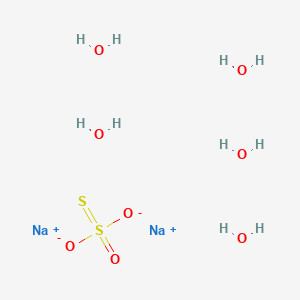
Sodium Thiosulfate Pentahydrate
Sodium thiosulfate pentahydrate is a hydrate consisting of sodium thiosulfate with 5 mol eq. of water. It has a role as a nephroprotective agent, an antifungal drug and an antidote to cyanide poisoning. It contains a sodium thiosulfate. — ChEBI
- IUPAC-Name
- disodium;dioxido-oxo-sulfanylidene-lambda6-sulfane;pentahydrate
- Summenformel
- H10Na2O8S2
- Molekulargewicht
- 248.19 g/mol
- Exakte Masse
- 247.96124818 Da
- Topologische polare Oberfläche
- 109,0 Ų
- Wasserstoffbrücken-Donoren
- 5
- Wasserstoffbrücken-Akzeptoren
- 9
- Kovalente Einheiten
- 8
- Definierte Stereozentren
- 0
Auch bekannt als
16 weitere gemeldete Namen
Kennungen in externen Datenbanken
- ChEBI:CHEBI:32150
- ChEMBL:CHEMBL2096650
- EPA DTXSID:DTXSID6044197
Belege aus weiteren wissenschaftlichen Datenbanken
EMBL-EBI ChEBI
sodium thiosulfate pentahydrate
A hydrate consisting of sodium thiosulfate with 5 mol eq. of water.
- Rezeptur
- 5H2O.2Na.O3S2
- Durchschnittsmasse
- 248.186 g/mol
- Monoisotopische Masse
- 247.96125 Da
- Formale Ladung
- 0
- hydrate — is a (CHEBI:35505)
- antidote to cyanide poisoning — has role (CHEBI:90749)
- nephroprotective agent — has role (CHEBI:76595)
- antifungal drug — has role (CHEBI:86327)
- sodium thiosulfate — has part (CHEBI:132112)
- antidote to cyanide poisoning — has role (CHEBI:90749)
- nephroprotective agent — has role (CHEBI:76595)
- antifungal drug — has role (CHEBI:86327)
- hydrate — is a (CHEBI:35505)
Weitere kuratierte Namen
Querverweise aus dieser Quelle
- CAS: 10102-17-7 — KEGG COMPOUND
- CAS: 10102-17-7 — ChemIDplus
- MANUAL_X_REF: D01091 — KEGG DRUG
- MANUAL_X_REF: DBSALT002505 — DrugBank
Zugeordnet durch: Exact CAS cross-reference in the ChEBI compound record. Quelle aktualisiert: 2024-05-17. Abgerufen: 2026-08-31. Quelleneintrag öffnen
NIH PubChem PUG-View
Attributed physical-property, hazard, environmental and use annotations.
- Density: 1.69 @25 °C Quelle: PAC Chemical Database, U.S. Department of Energy
- Melting Point: 48 °C Quelle: PAC Chemical Database, U.S. Department of Energy
- Physical Description: Large Crystals; Dry Powder; Other Solid Quelle: EPA Chemical Data Reporting (CDR)
- Physical Description: Odorless solid; Deliquesces slightly in moist air; [Merck Index] Colorless odorless crystalline solid; [Sigma-Aldrich MSDS] Quelle: Haz-Map, Information on Hazardous Chemicals and Occupational Diseases
- Note: This chemical does not meet GHS hazard criteria for 98.6% (277 of 281) of all reports. Quelle: European Chemicals Agency (ECHA)
- GHS Hazard Statements: Not Classified; Reported as not meeting GHS hazard criteria by 277 of 281 companies (only 1.4% companies provided GHS information). For more detailed information, please visit ECHA C&L website. Quelle: European Chemicals Agency (ECHA)
- ECHA C&L Notifications Summary: Aggregated GHS information provided per 281 reports by companies from 6 notifications to the ECHA C&L Inventory.; Reported as not meeting GHS hazard criteria per 277 of 281 reports by companies.; There are 4 notifications provided by 4 of 281 reports by companies with hazard statement code(s).; Information may vary between notifications depending on impurities, additives, and other factors. The percentage value in parenthesis indicates the notified classification ratio from companies that provide hazard codes. Only hazard codes with percentage values above 10% are shown. For more detailed information, please visit ECHA C&L website. Quelle: European Chemicals Agency (ECHA)
- Consumer Uses: Not Known or Reasonably Ascertainable Quelle: EPA Chemical Data Reporting (CDR)
- Industry Uses: Laboratory chemicals; Reducing agent; Not Known or Reasonably Ascertainable; Cleaning agent; Dehydrating agent (desiccant); Processing aids not otherwise specified; Tanning agents not otherwise specified Quelle: EPA Chemical Data Reporting (CDR)
- Sources/Uses: Used to remove chlorine from solutions; to bleach paper, bone, straw, and ivory; as a fixer in photography; to extract silver from ores; as mordant in dyeing and printing textiles; in leather manufacturing; in pharmaceutical production (antioxidant), and as an antidote for cyanide poisoning; [Merck Index] Permitted for use as an inert ingredient in non-food pesticide products; [EPA] Quelle: Haz-Map, Information on Hazardous Chemicals and Occupational Diseases
- Industrial Processes with risk of exposure: Pulp and Paper Processing [Category: Industry]; Leather Tanning and Processing [Category: Industry]; Photographic Processing [Category: Other]; Textiles (Printing, Dyeing, or Finishing) [Category: Industry]; Metal Extraction and Refining [Category: Industry] Quelle: Haz-Map, Information on Hazardous Chemicals and Occupational Diseases
Zugeordnet durch: Existing checksum-valid CAS to unique PubChem CID match. Abgerufen: 2026-08-31. Quelleneintrag öffnen
Wissenschaftliche Klassifizierungen und Gefahrenannotationen liefern Kontext und ersetzen nicht die oben gezeigte marktspezifische regulatorische Entscheidung.
Weitere Quellenabdeckung und Trefferstatus
| Quelle | Ergebnis | Geprüft |
|---|---|---|
| EMBL-EBI ChEBI | Exakter Treffer | 2026-08-31 |
| NIH PubChem PUG-View | Exakter Treffer | 2026-08-31 |
Ein erfasster Nicht-Treffer ist ein nützlicher Beleg dafür, dass die Quelle geprüft wurde; er ist keine Behauptung, dass der Stoff anderswo nicht existiert.
Am 2026-08-31 von NIH PubChem durch prüfsummengültigen CAS-Abgleich abgerufen. Chemische Eigenschaften ersetzen nicht die regulatorische Entscheidung auf dieser Seite.