
CAS
1 Eintrag
CAS 101-21-3
CAS 101-21-3 entspricht 1 EU-Anhangseintrag in den Anhängen II–VI der Verordnung (EG) Nr. 1223/2009.
Einträge zu CAS 101-21-3
1 insgesamtChemische Identität und Eigenschaften
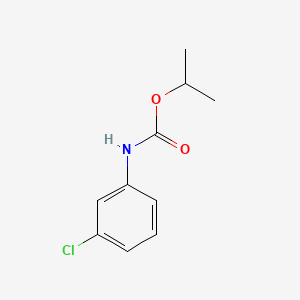
CAS 101-21-3PubChem CID 2728
Chlorpropham
Chlorpropham is a carbamate ester that is the isopropyl ester of 3-chlorophenylcarbamic acid. It has a role as a herbicide and a plant growth retardant. It is a member of benzenes, a carbamate ester and a member of monochlorobenzenes. — ChEBI
- IUPAC-Name
- propan-2-yl N-(3-chlorophenyl)carbamate
- Summenformel
- C10H12ClNO2
- Molekulargewicht
- 213.66 g/mol
- Exakte Masse
- 213.0556563 Da
- XLogP3
- 3,5
- Topologische polare Oberfläche
- 38,3 Ų
- Wasserstoffbrücken-Donoren
- 1
- Wasserstoffbrücken-Akzeptoren
- 2
- Kovalente Einheiten
- 1
- Definierte Stereozentren
- 0
Auch bekannt als
CHLOROPROPHAMChloro-IPCCIPCisopropyl (3-chlorophenyl)carbamatePreventolElbanilMetoxonNexoval
16 weitere gemeldete Namen
Isopropyl N-(3-chlorophenyl)carbamateChlorprophameTaterpexTriherbicide CIPCMirvalePreventol 56PreweedLiro CIPCKeim-stopStopgerme-SSprout NipChlorIPCIsopropyl m-chlorocarbanilateSpud-NicSpud-NieChloro-IFK
Kennungen in externen Datenbanken
- ChEBI:CHEBI:34630
- ChEMBL:CHEMBL104560
- EPA DTXSID:DTXSID7020764
- PubMed:26359731
- PubMed:25028461
- PubMed:23008280
- PubMed:22717791
- PubMed:21909624
- PubMed:21757399
- PubMed:21515967
- PubMed:21310686
- PubMed:21153805
- PubMed:21115097
- PubMed:20810355
- PubMed:20433090
Belege aus weiteren wissenschaftlichen Datenbanken
EMBL-EBI ChEBI
Exakter KennungstrefferCHEBI:34630
chlorpropham
A carbamate ester that is the isopropyl ester of 3-chlorophenylcarbamic acid.
- Rezeptur
- C10H12ClNO2
- Durchschnittsmasse
- 213.664 g/mol
- Monoisotopische Masse
- 213.05566 Da
- Formale Ladung
- 0
- benzenes — is a (CHEBI:22712)
- carbamate ester — is a (CHEBI:23003)
- monochlorobenzenes — is a (CHEBI:83403)
- herbicide — has role (CHEBI:24527)
- plant growth retardant — has role (CHEBI:35219)
- herbicide — has role (CHEBI:24527)
- plant growth retardant — has role (CHEBI:35219)
- benzenes — is a (CHEBI:22712)
- carbamate ester — is a (CHEBI:23003)
- monochlorobenzenes — is a (CHEBI:83403)
Weitere kuratierte Namen
propan-2-yl (3-chlorophenyl)carbamate1-Methylethyl (3-chlorophenyl)carbamate3-Chlorocarbanilic acid, isopropyl ester(3-Chlorophenyl)carbamic acid, 1-methylethyl esterChloroprophamChlorprophameIsopropyl 3-chlorocarbanilateisopropyl (3-chlorophenyl)carbamateIsopropyl 3-chlorophenylcarbamateIsopropyl m-chlorocarbanilateIsopropyl-m-chlorocarbanilateIsopropyl meta-chlorocarbanilateIsopropyl N-(3-chlorophenyl)carbamateIsopropyl-N-(3-chlorophenyl)carbamateIsopropyl-N-3-chlorophenyl carbamateIsopropyl-N-(3-chlorphenyl)-carbamatIsopropyl N-(m-chlorophenyl)carbamateIsopropyl-N-m-chlorophenyl-carbamatem-Chlorocarbanilic acid isopropyl esterm-Chlorocarbanilic acid, isopropyl esterN-(3-Chlorophenyl)carbamic acid, isopropyl esterN-(3-Chlorophenyl)isopropyl carbamateN-3-ChlorophenylisopropylcarbamateO-Isopropyl N-(3-chlorophenyl)carbamate
Querverweise aus dieser Quelle
- CAS: 101-21-3 — ChemIDplus
- CAS: 101-21-3 — KEGG COMPOUND
- CAS: 101-21-3 — NIST Chemistry WebBook
- MANUAL_X_REF: 153 — PPDB
- MANUAL_X_REF: C14506 — KEGG COMPOUND
- MANUAL_X_REF: Chlorpropham — Wikipedia
- REGISTRY_NUMBER: 2211397 — Reaxys
Zugeordnet durch: Exact CAS cross-reference in the ChEBI compound record. Quelle aktualisiert: 2014-10-24. Abgerufen: 2026-08-31. Quelleneintrag öffnen
NIH PubChem PUG-View
Exakter Kennungstreffer2728
Attributed physical-property, hazard, environmental and use annotations.
- Boiling Point: 477 °F at 760 mmHg (decomposition) (NTP, 1992) Quelle: CAMEO Chemicals
- Boiling Point: 149 °C at 2 mm Hg Quelle: Hazardous Substances Data Bank (HSDB)
- Boiling Point: Boiling point: 246 °C with decomposition Quelle: Hazardous Substances Data Bank (HSDB)
- Color/Form: Colorless solid Quelle: Hazardous Substances Data Bank (HSDB)
- Color/Form: Light-tan powder Quelle: Hazardous Substances Data Bank (HSDB)
- Color/Form: Light brown crystalline solid Quelle: Hazardous Substances Data Bank (HSDB)
- Density: 1.18 at 86 °F (NTP, 1992) - Denser than water; will sink Quelle: CAMEO Chemicals
- Density: 1.180 at 30 °C Quelle: Hazardous Substances Data Bank (HSDB)
- Density: 1.18 g/cm³ Quelle: ILO-WHO International Chemical Safety Cards (ICSCs)
- LogP: log Kow= 3.51 Quelle: Hazardous Substances Data Bank (HSDB)
- LogP: 3.4 Quelle: ILO-WHO International Chemical Safety Cards (ICSCs)
- Melting Point: 106.5 °F (NTP, 1992) Quelle: CAMEO Chemicals
- Melting Point: 40.7-41.1 °C Quelle: Hazardous Substances Data Bank (HSDB)
- Melting Point: 41 °C Quelle: ILO-WHO International Chemical Safety Cards (ICSCs)
- Odor: Faint characteristic odor Quelle: Hazardous Substances Data Bank (HSDB)
- Odor: Very faint odor Quelle: Hazardous Substances Data Bank (HSDB)
- Physical Description: Isopropyl-n-(3-chlorophenyl)carbamate is a brown chunky solid. (NTP, 1992) Quelle: CAMEO Chemicals
- Physical Description: Colorless to light tan solid; [HSDB] Commercial product is a liquid; [Merck Index] Slightly beige solid; [MSDSonline] Quelle: Haz-Map, Information on Hazardous Chemicals and Occupational Diseases
- Physical Description: COLOURLESS-TO-BROWN CRYSTALS. Quelle: ILO-WHO International Chemical Safety Cards (ICSCs)
- Refractive Index: Index of refraction: 1.5388 at 20 °C/D Quelle: Hazardous Substances Data Bank (HSDB)
- Refractive Index: Index of refraction: 1.5395 at 20 °C/D (supercooled) Quelle: Hazardous Substances Data Bank (HSDB)
- Solubility: less than 1 mg/mL at 64 °F (NTP, 1992) Quelle: CAMEO Chemicals
- Solubility: Readily soluble in most organic solvents (e.g., alcohols, ketones, esters, chlorinated hydrocarbons, aromatic hydrocarbons); moderately soluble in mineral oils (100 g/kg kerosene) Quelle: Hazardous Substances Data Bank (HSDB)
- Solubility: Miscible in acetone, carbon disulfide; very soluble in anhydrous ammonia, aromatic solvents, ethyl and isopropyl alcohol, ketones; soluble in kerosene or diesel oil Quelle: Hazardous Substances Data Bank (HSDB)
- Solubility: In water, 89 mg/L at 25 °C Quelle: Hazardous Substances Data Bank (HSDB)
- Solubility: Solubility in water, g/100ml: 0.009 (very poor) Quelle: ILO-WHO International Chemical Safety Cards (ICSCs)
- Vapor Pressure: 2 mmHg at 300 °F (NTP, 1992) Quelle: CAMEO Chemicals
- Vapor Pressure: 0.0000075 [mmHg] Quelle: Haz-Map, Information on Hazardous Chemicals and Occupational Diseases
- Vapor Pressure: Vapor pressure = 2 mm Hg at 149 °C Quelle: Hazardous Substances Data Bank (HSDB)
- Vapor Pressure: 24 mPa (1.8X10⁻⁴ mm Hg) at 20 °C (98% pure) Quelle: Hazardous Substances Data Bank (HSDB)
- IARC Carcinogenic Agent: Chloropropham Quelle: International Agency for Research on Cancer (IARC)
- IARC Carcinogenic Classes: Group 3: Not classifiable as to its carcinogenicity to humans Quelle: International Agency for Research on Cancer (IARC)
- IARC Monographs: Volume 12: (1976) Some Carbamates, Thiocarbamates and Carbazides; Volume Sup 7: Overall Evaluations of Carcinogenicity: An Updating of IARC Monographs Volumes 1 to 42, 1987; 440 pages; ISBN 92-832-1411-0 (out of print) Quelle: International Agency for Research on Cancer (IARC)
- Publication Year: 1987 Quelle: International Agency for Research on Cancer (IARC)
- Evaluation Year: 1987 Quelle: International Agency for Research on Cancer (IARC)
- Carcinogen Classification: 3, not classifiable as to its carcinogenicity to humans. (L135) Quelle: Toxin and Toxin Target Database (T3DB)
- Exposure Routes: Inhalation (L793) ; oral (L793); dermal (L793) Quelle: Toxin and Toxin Target Database (T3DB)
- First Aid: EYES: First check the victim for contact lenses and remove if present. Flush victim's eyes with water or normal saline solution for 20 to 30 minutes while simultaneously calling a hospital or poison control center. Do not put any ointments, oils, or medication in the victim's eyes without specific instructions from a physician. IMMEDIATELY transport the victim after flushing eyes to a hospital even if no symptoms (such as redness or irritation) develop.; SKIN: IMMEDIATELY flood affected skin with water while removing and isolating all contaminated clothing. Gently wash all affected skin areas thoroughly with soap and water. If symptoms such as redness or irritation develop, IMMEDIATELY call a physician and be prepared to transport the victim to a hospital for treatment.; INHALATION: IMMEDIATELY leave the contaminated area; take deep breaths of fresh air. If symptoms (such as wheezing, coughing, shortness of breath, or burning in the mouth, throat, or chest) develop, call a physician and be prepared to transport the victim to a hospital. Provide proper respiratory protection to rescuers entering an unknown atmosphere. Whenever possible, Self-Contained Breathing Apparatus (SCBA) shou Quelle: CAMEO Chemicals
- Signal: Warning Quelle: Regulation (EC) No 1272/2008 of the European Parliament and of the Council
- GHS Hazard Statements: H351: Suspected of causing cancer [Warning Carcinogenicity]; H373 **: May causes damage to organs through prolonged or repeated exposure [Warning Specific target organ toxicity, repeated exposure]; H411: Toxic to aquatic life with long lasting effects [Hazardous to the aquatic environment, long-term hazard] Quelle: Regulation (EC) No 1272/2008 of the European Parliament and of the Council
- Precautionary Statement Codes: P203, P260, P273, P280, P318, P319, P391, P405, and P501 (click each P-code to see the statement) Quelle: Regulation (EC) No 1272/2008 of the European Parliament and of the Council
- Note: This chemical does not meet GHS hazard criteria for 1.4% (1 of 71) of reports. Quelle: European Chemicals Agency (ECHA)
- Signal: Warning Quelle: European Chemicals Agency (ECHA)
- GHS Hazard Statements: H351 (98.6%): Suspected of causing cancer [Warning Carcinogenicity]; H373 (98.6%): May causes damage to organs through prolonged or repeated exposure [Warning Specific target organ toxicity, repeated exposure]; H411 (98.6%): Toxic to aquatic life with long lasting effects [Hazardous to the aquatic environment, long-term hazard] Quelle: European Chemicals Agency (ECHA)
- Precautionary Statement Codes: P203, P260, P273, P280, P318, P319, P391, P405, and P501 (click each P-code to see the statement) Quelle: European Chemicals Agency (ECHA)
- ECHA C&L Notifications Summary: Aggregated GHS information provided per 71 reports by companies from 10 notifications to the ECHA C&L Inventory. Each notification may be associated with multiple companies.; Reported as not meeting GHS hazard criteria per 1 of 71 reports by companies.; There are 9 notifications provided by 70 of 71 reports by companies with hazard statement code(s).; Information may vary between notifications depending on impurities, additives, and other factors. The percentage value in parenthesis indicates the notified classification ratio from companies that provide hazard codes. Only hazard codes with percentage values above 10% are shown. For more detailed information, please visit ECHA C&L website. Quelle: European Chemicals Agency (ECHA)
- Signal: Danger Quelle: NITE-CMC
- GHS Hazard Statements: H320: Causes eye irritation [Warning Serious eye damage/eye irritation]; H332: Harmful if inhaled [Warning Acute toxicity, inhalation]; H351: Suspected of causing cancer [Warning Carcinogenicity]; H361: Suspected of damaging fertility or the unborn child [Warning Reproductive toxicity]; H370: Causes damage to organs [Danger Specific target organ toxicity, single exposure]; H371: May cause damage to organs [Warning Specific target organ toxicity, single exposure]; H373: May causes damage to organs through prolonged or repeated exposure [Warning Specific target organ toxicity, repeated exposure]; H401: Toxic to aquatic life [Hazardous to the aquatic environment, acute hazard]; H411: Toxic to aquatic life with long lasting effects [Hazardous to the aquatic environment, long-term hazard] Quelle: NITE-CMC
- Precautionary Statement Codes: P203, P260, P261, P264, P264+P265, P270, P271, P273, P280, P304+P340, P305+P351+P338, P308+P316, P317, P318, P319, P321, P337+P317, P391, P405, and P501 (click each P-code to see the statement) Quelle: NITE-CMC
- Signal: Warning Quelle: Hazardous Chemical Information System (HCIS), Safe Work Australia
- Health Effects: Acute exposure to cholinesterase inhibitors can cause a cholinergic crisis characterized by severe nausea/vomiting, salivation, sweating, bradycardia, hypotension, collapse, and convulsions. Increasing muscle weakness is a possibility and may result in death if respiratory muscles are involved. Accumulation of ACh at motor nerves causes overstimulation of nicotinic expression at the neuromuscular junction. When this occurs symptoms such as muscle weakness, fatigue, muscle cramps, fasciculation, and paralysis can be seen. When there is an accumulation of ACh at autonomic ganglia this causes overstimulation of nicotinic expression in the sympathetic system. Symptoms associated with this are hypertension, and hypoglycemia. Overstimulation of nicotinic acetylcholine receptors in the central nervous system, due to accumulation of ACh, results in anxiety, headache, convulsions, ataxia, depression of respiration and circulation, tremor, general weakness, and potentially coma. When there is expression of muscarinic overstimulation due to excess acetylcholine at muscarinic acetylcholine receptors symptoms of visual disturbances, tightness in chest, wheezing due to bronchoconstriction, incre Quelle: Toxin and Toxin Target Database (T3DB)
- Target Organs: Hematologic; Hepatic; Immune; Urinary Quelle: EPA Integrated Risk Information System (IRIS)
- Toxicity Summary: Chlorpropham is a cholinesterase or acetylcholinesterase (AChE) inhibitor. Carbamates form unstable complexes with chlolinesterases by carbamoylation of the active sites of the enzymes. This inhibition is reversible. A cholinesterase inhibitor suppresses the action of acetylcholine esterase. Because of its essential function, chemicals that interfere with the action of acetylcholine esterase are potent neurotoxins, causing excessive salivation and eye-watering in low doses. Headache, salivation, nausea, vomiting, abdominal pain and diarrhea are often prominent at higher levels of exposure. Acetylcholine esterase breaks down the neurotransmitter acetylcholine, which is released at nerve and muscle junctions, in order to allow the muscle or organ to relax. The result of acetylcholine esterase inhibition is that acetylcholine builds up and continues to act so that any nerve impulses are continually transmitted and muscle contractions do not stop. Quelle: Toxin and Toxin Target Database (T3DB)
- Environmental Bioconcentration: An estimated BCF of 100 was calculated for chlorpropham(SRC), using a log Kow of 3.51(1) and a regression-derived equation(2). According to a classification scheme(3), this BCF suggests the potential for bioconcentration in aquatic organisms is moderate(SRC). Quelle: Hazardous Substances Data Bank (HSDB)
- Environmental Fate: TERRESTRIAL FATE: Based on a classification scheme(1), Koc values ranging from 245 to 816(2-5), indicates that chlorpropham is expected to have moderate to low mobility in soil(SRC). Volatilization of chlorpropham from moist soil surfaces is not expected to be an important fate process(SRC) given an estimated Henry's Law constant of 5.7X10⁻⁷ atm-cu m/mole(SRC),derived from its vapor pressure 1.8X10⁻⁴ mm Hg(6) and, water solubility, 89 mg/L(6). Chlorpropham is not expected to volatilize from dry soil surfaces(SRC) based upon its vapor pressure of 1.8X10⁻⁴ mm Hg(6). The leaching of chlorpropham from three types of soil was low and more than 90% of chlorpropham was found in the upper inch of the soil after 4 cm of rain(7). Depending on the nature of soil and climatic conditions, the field half-lives of chlorpropham in soil range from less than 30 days to 65 days(8) with an average half-life of 30 days(9). Quelle: Hazardous Substances Data Bank (HSDB)
- Environmental Fate: AQUATIC FATE: Based on a classification scheme(1), Koc values ranging from 245 to 816(2-5), indicate that chlorpropham is expected to adsorb to suspended solids and sediment(SRC). Volatilization from water surfaces is not expected(6) based upon an estimated Henry's Law constant of 5.7X10⁻⁷ atm-cu m/mole(SRC), derived from its vapor pressure, 1.8X10⁻⁴ mm Hg(7), and water solubility, 89 mg/L(7). According to a classification scheme(8), an estimated BCF of 100(SRC), from its log Kow of 3.51(9) and a regression-derived equation(10), suggests the potential for bioconcentration in aquatic organisms is moderate(SRC). Chlorpropham was found to not hydrolyze in aqueous buffer solution at pH 4, 7, and 9(11). Based on a mean rate constant of 2.6X10⁻¹⁴ L/organism-hr and a bacterial concn of 5X10+8 organisms/L in water, the half-life of chlorpropham has been estimated to be 2208 days(12). Therefore, biodegradation of chlorpropham should not be important in clear bodies of water(SRC). However, biodegradation may become important if the bacterial population in water is several orders of magnitude higher than 10+8 organisms(13). The estimated minimum half-life for the direct sunlight photolysis of Quelle: Hazardous Substances Data Bank (HSDB)
- Environmental Fate: ATMOSPHERIC FATE: According to a model of gas/particle partitioning of semivolatile organic compounds in the atmosphere(1), chlorpropham, which has a vapor pressure of 1.8X10⁻⁴ mm Hg at 20 °C(2), is expected to exist solely as a vapor in the ambient atmosphere. Vapor-phase chlorpropham is degraded in the atmosphere by reaction with photochemically-produced hydroxyl radicals(SRC); the half-life for this reaction in air is estimated to be 9.7 hours (SRC), calculated from its rate constant of 4.0X10⁻¹¹ cu cm/molecule-sec at 25 °C(SRC) that was derived using a structure estimation method(3). Chlorpropham does not absorb light with wavelengths >290 nm(4), and is therefore not expected to be susceptible to direct photolysis by sunlight. Quelle: Hazardous Substances Data Bank (HSDB)
- Environmental Fate: MOIST SOIL TREATED WITH CHLORPROPHAM TO GIVE CONCN OF 100 PPM AI WAS INCUBATED IN POLYETHYLENE BAGS @ 23 °C FOR 30 WK. CO2 EVOLUTION WAS DETERMINED WEEKLY. CHLORPROPHAM WAS DEGRADED RAPIDLY IN FIRST 6WK & 5% OF ORIGINAL AMT COULD BE DETECTED 30 WK LATER. Quelle: Hazardous Substances Data Bank (HSDB)
- Sources/Uses: Used as a herbicide to control many annual grassy and broadleaf weeds in alfalfa, lima and snap beans, blueberries, cane berries, cranberries, carrots, ladino clover, garlic, seed grass, peas, onions, spinach, sugar beets, tomatoes, safflower, soybeans, gladioli, and woody nursery stock; Also used to inhibit potato sprouting and for systemic sucker control in tobacco; [HSDB] Quelle: Haz-Map, Information on Hazardous Chemicals and Occupational Diseases
- Uses: For chloropropham (USEPA/OPP Pesticide Code: 018301) ACTIVE products with label matches. /SRP: Registered for use in the U.S. but approved pesticide uses may change periodically and so federal, state and local authorities must be consulted for currently approved uses./ Quelle: Hazardous Substances Data Bank (HSDB)
- Uses: Chlorpropham acts as highly selective preemergence and early postemergence herbicide; it effectively controls many annual grassy and broadleaf weeds; application during late fall and winter for control of some perennial weeds. Quelle: Hazardous Substances Data Bank (HSDB)
- Uses: For control of weeds in alfalfa, lima and snap beans, blueberries, cane berries, cranberries, carrots, ladino clover, garlic, seed grass, peas, onions, spinach, sugar beets, tomatoes, safflower, soybeans, gladioli, woody nursery stock. Also for inhibiting potato sprouting and systemic sucker control in tobacco. Quelle: Hazardous Substances Data Bank (HSDB)
- Uses: Chlorpropham is widely used as an insecticide or pesticide in homes, gardens and agricultural applications. It is a synthetic compound. Quelle: Toxin and Toxin Target Database (T3DB)
Zugeordnet durch: Existing checksum-valid CAS to unique PubChem CID match. Abgerufen: 2026-08-31. Quelleneintrag öffnen
Wissenschaftliche Klassifizierungen und Gefahrenannotationen liefern Kontext und ersetzen nicht die oben gezeigte marktspezifische regulatorische Entscheidung.
Weitere Quellenabdeckung und Trefferstatus
| Quelle | Ergebnis | Geprüft |
|---|---|---|
| EMBL-EBI ChEBI | Exakter Treffer | 2026-08-31 |
| NIH PubChem PUG-View | Exakter Treffer | 2026-08-31 |
Ein erfasster Nicht-Treffer ist ein nützlicher Beleg dafür, dass die Quelle geprüft wurde; er ist keine Behauptung, dass der Stoff anderswo nicht existiert.
Am 2026-09-02 von NIH PubChem durch prüfsummengültigen CAS-Abgleich abgerufen. Chemische Eigenschaften ersetzen nicht die regulatorische Entscheidung auf dieser Seite.
Wie CAS 101-21-3 auf dieser Website verwendet wird
CAS 101-21-3 ist die Kennung des Chemical Abstracts Service, mit der diese Seite einem bestimmten Stoff zugeordnet wird. Im aktuellen Datenbestand hat 1 EU-Anhangseintrag diese Kennung; so können Sie gegenprüfen, ob derselbe Stoff in einem oder in mehreren regulatorischen Zusammenhängen auftaucht.
Nutzen Sie diese Seite, wenn eine Lieferantenspezifikation, ein Sicherheitsdatenblatt oder ein Rohstoffdossier CAS 101-21-3 nennt und Sie alle verknüpften Einträge der Anhänge II–VI an einem Ort sehen möchten. Die Eintragskarten oben sind der schnellste Weg zu Konzentrationsgrenzen, Warnhinweisen, Anhangszuordnung und Produktartbedingungen.
Häufig gestellte Fragen
Ein durch CAS 101-21-3 identifizierter Stoff kann in mehreren Anhängen der EU-Kosmetikverordnung vorkommen, wenn er in unterschiedlichen Zusammenhängen unterschiedlichen Bedingungen unterliegt. Ein Stoff kann beispielsweise nach Anhang III mit bestimmten Bedingungen beschränkt sein, und dieselbe CAS-Nummer kann auch in Anhang IV als zugelassener Farbstoff unter eigenen Eintragsbedingungen erscheinen. Jeder Eintrag muss einzeln geprüft werden.
Gleichen Sie die CAS-Nummer mit den Spezifikationsblättern und Analysenzertifikaten Ihrer Rohstoffe ab. Erscheint eine CAS-Nummer in Anhang II, prüfen Sie die Abwesenheit des Stoffs. Erscheint sie in Anhang III, prüfen Sie, ob Konzentrationsgrenzen und Produktartbedingungen in Ihrer Rezeptur eingehalten werden. Alle Anhangseinträge mit dieser CAS-Nummer sind oben aufgeführt.
Eine CAS-Nummer wird vom Chemical Abstracts Service (USA) vergeben und ist weltweit anerkannt. Eine EC-Nummer ist eine Kennung der Europäischen Kommission aus Verzeichnissen wie EINECS, ELINCS oder der NLP-Liste. Beide Kennungen können in Einträgen der EU-Kosmetikanhänge vorkommen. Manche Stoffe haben beide, manche nur eine, und einige ältere Einträge haben möglicherweise keine von beiden.
Der INCI-Checker akzeptiert Inhaltsstoffnamen, CAS-Nummern und EC-Nummern. Prüfen Sie diese CAS-Nummer direkt und gleichen Sie das Ergebnis anschließend mit den Spezifikationsblättern der Lieferanten und allen verknüpften Anhangsbedingungen ab.
Werkzeuge und nächste Schritte
Rezeptur prüfen
Eine vollständige INCI-Liste prüfen und anschließend mit CAS 101-21-3 Lieferantendokumente zu den gefundenen Stoffen gegenprüfen.
INCI-CheckerNach Name suchen
Nach INCI-Namen, Aliasen oder verwandten Kennungen suchen, die in Ihrer Dokumentation neben CAS 101-21-3 stehen.
Suche