
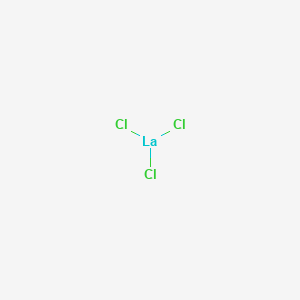
Lanthanum chloride (LaCl3)
Lanthanum chloride appears as white crystalline solid. Gives an amber aqueous solution that can cause destruction or irreversible alterations in human skin tissue at the site of contact. Has a severe corrosion rate on steel. — CAMEO Chemicals
- IUPAC-Name
- trichlorolanthanum
- Summenformel
- Cl3La
- Molekulargewicht
- 245.26 g/mol
- Exakte Masse
- 243.812921 Da
- Topologische polare Oberfläche
- 0,0 Ų
- Wasserstoffbrücken-Donoren
- 0
- Wasserstoffbrücken-Akzeptoren
- 0
- Kovalente Einheiten
- 1
- Definierte Stereozentren
- 0
Auch bekannt als
16 weitere gemeldete Namen
Kennungen in externen Datenbanken
- ChEBI:CHEBI:231515
- EPA DTXSID:DTXSID2051502
Belege aus weiteren wissenschaftlichen Datenbanken
EMBL-EBI ChEBI
lanthanum trichloride
The trichloride salt of lanthanum.
- Rezeptur
- Cl3La
- Durchschnittsmasse
- 245.265 g/mol
- Monoisotopische Masse
- 243.81291 Da
- Formale Ladung
- 0
- inorganic chloride — is a (CHEBI:36093)
- inorganic lanthanum salt — is a (CHEBI:190476)
- antineoplastic agent — has role (CHEBI:35610)
- neurotoxin — has role (CHEBI:50910)
- apoptosis inducer — has role (CHEBI:68495)
- autophagy inducer — has role (CHEBI:138880)
- NMR chemical shift reference compound — has role (CHEBI:228364)
- antineoplastic agent — has role (CHEBI:35610)
- neurotoxin — has role (CHEBI:50910)
- apoptosis inducer — has role (CHEBI:68495)
- autophagy inducer — has role (CHEBI:138880)
- NMR chemical shift reference compound — has role (CHEBI:228364)
- inorganic chloride — is a (CHEBI:36093)
- inorganic lanthanum salt — is a (CHEBI:190476)
- 25048927 Quelle: PubMed
- 29698762 Quelle: PubMed
- 30116365 Quelle: PubMed
- 30617363 Quelle: PubMed
- 31187842 Quelle: PubMed
- 31776842 Quelle: PubMed
- 32461997 Quelle: PubMed
- 33206094 Quelle: PubMed
- 34688703 Quelle: PubMed
- 34977076 Quelle: PubMed
- 35303612 Quelle: PubMed
- 35661286 Quelle: PubMed
- 35727352 Quelle: PubMed
- 35809677 Quelle: PubMed
- 36006215 Quelle: PubMed
- 37767339 Quelle: PubMed
- 37837874 Quelle: PubMed
- 38222531 Quelle: PubMed
- 38322316 Quelle: PubMed
Weitere kuratierte Namen
Querverweise aus dieser Quelle
- CAS: 10099-58-8 — NIST Chemistry WebBook
- MANUAL_X_REF: Lanthanum(III)_chloride — Wikipedia
Zugeordnet durch: Exact CAS cross-reference in the ChEBI compound record. Quelle aktualisiert: 2024-06-12. Abgerufen: 2026-08-31. Quelleneintrag öffnen
NIH PubChem PUG-View
Attributed physical-property, hazard, environmental and use annotations.
- Boiling Point: 1000 °C @760 [mm Hg] Quelle: PAC Chemical Database, U.S. Department of Energy
- Density: 3.84 @25 °C Quelle: PAC Chemical Database, U.S. Department of Energy
- Physical Description: Lanthanum chloride appears as white crystalline solid. Gives an amber aqueous solution that can cause destruction or irreversible alterations in human skin tissue at the site of contact. Has a severe corrosion rate on steel. Quelle: CAMEO Chemicals
- Physical Description: CBI; Wet Solid; Liquid Quelle: EPA Chemical Data Reporting (CDR)
- Physical Description: White crystalline solid. [CAMEO] (Heptahydrate) Hygroscopic; Soluble in water; [Hawley] Quelle: Haz-Map, Information on Hazardous Chemicals and Occupational Diseases
- First Aid: Excerpt from ERG Guide 154 [Substances - Toxic and/or Corrosive (Non-Combustible)]:; Refer to the "General First Aid" section. Specific First Aid: For corrosives, in case of contact, immediately flush skin or eyes with running water for at least 30 minutes. Additional flushing may be required. (ERG, 2024) Quelle: CAMEO Chemicals
- Signal: Danger Quelle: European Chemicals Agency (ECHA)
- GHS Hazard Statements: H290 (33.6%): May be corrosive to metals [Warning Corrosive to Metals]; H315 (17.1%): Causes skin irritation [Warning Skin corrosion/irritation]; H317 (82.9%): May cause an allergic skin reaction [Warning Sensitization, Skin]; H318 (82.9%): Causes serious eye damage [Danger Serious eye damage/eye irritation]; H319 (17.1%): Causes serious eye irritation [Warning Serious eye damage/eye irritation]; H335 (17.1%): May cause respiratory irritation [Warning Specific target organ toxicity, single exposure; Respiratory tract irritation]; H411 (82.9%): Toxic to aquatic life with long lasting effects [Hazardous to the aquatic environment, long-term hazard] Quelle: European Chemicals Agency (ECHA)
- Precautionary Statement Codes: P234, P261, P264, P264+P265, P271, P272, P273, P280, P302+P352, P304+P340, P305+P351+P338, P305+P354+P338, P317, P319, P321, P332+P317, P333+P317, P337+P317, P362+P364, P390, P391, P403+P233, P405, P406, and P501 (click each P-code to see the statement) Quelle: European Chemicals Agency (ECHA)
- ECHA C&L Notifications Summary: Aggregated GHS information provided per 211 reports by companies from 8 notifications to the ECHA C&L Inventory. Each notification may be associated with multiple companies.; Information may vary between notifications depending on impurities, additives, and other factors. The percentage value in parenthesis indicates the notified classification ratio from companies that provide hazard codes. Only hazard codes with percentage values above 10% are shown. For more detailed information, please visit ECHA C&L website. Quelle: European Chemicals Agency (ECHA)
- Consumer Uses: Other; Solids separation (precipitating) agent, not otherwise specified; Flocculating agent Quelle: EPA Chemical Data Reporting (CDR)
- Industry Uses: Catalyst; Intermediate; Flocculating agent; Solids separation (precipitating) agent, not otherwise specified; Other Quelle: EPA Chemical Data Reporting (CDR)
- Sources/Uses: Used to prepare lanthanum; [Hawley] Quelle: Haz-Map, Information on Hazardous Chemicals and Occupational Diseases
Zugeordnet durch: Existing checksum-valid CAS to unique PubChem CID match. Abgerufen: 2026-08-31. Quelleneintrag öffnen
Wissenschaftliche Klassifizierungen und Gefahrenannotationen liefern Kontext und ersetzen nicht die oben gezeigte marktspezifische regulatorische Entscheidung.
Weitere Quellenabdeckung und Trefferstatus
| Quelle | Ergebnis | Geprüft |
|---|---|---|
| EMBL-EBI ChEBI | Exakter Treffer | 2026-08-31 |
| NIH PubChem PUG-View | Exakter Treffer | 2026-08-31 |
Ein erfasster Nicht-Treffer ist ein nützlicher Beleg dafür, dass die Quelle geprüft wurde; er ist keine Behauptung, dass der Stoff anderswo nicht existiert.
Am 2026-08-31 von NIH PubChem durch prüfsummengültigen CAS-Abgleich abgerufen. Chemische Eigenschaften ersetzen nicht die regulatorische Entscheidung auf dieser Seite.