
Iron Oxide Black
CI 77499
Iron Oxide Black steht in Anhang IV als Eintrag der Positivliste für Farbstoffe in kosmetischen Mitteln der EU.
Eintragsdetails
Warnhinweise
Purity criteria as set out in Commission Directive 95/45/EC (E172)
Colour Index oder Glossar
CI 77499
Chemische Bezeichnung
Iron Oxide Black
Chemische / IUPAC-Bezeichnung
Iron Oxide Black
Farbe
Black
Regulatorische Informationen
Identifizierte Inhaltsstoffe
Kerndaten
Chemische Identität und Eigenschaften
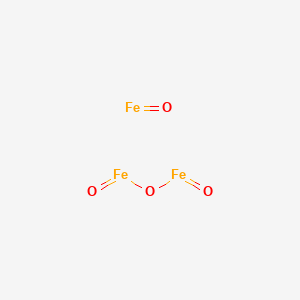
Iron oxide (Fe3O4)
- IUPAC-Name
- oxoiron;oxo(oxoferriooxy)iron
- Summenformel
- Fe3O4
- Molekulargewicht
- 231.53 g/mol
- Exakte Masse
- 231.784465 Da
- Topologische polare Oberfläche
- 60,4 Ų
- Wasserstoffbrücken-Donoren
- 0
- Wasserstoffbrücken-Akzeptoren
- 4
- Kovalente Einheiten
- 2
- Definierte Stereozentren
- 0
Auch bekannt als
16 weitere gemeldete Namen
Belege aus weiteren wissenschaftlichen Datenbanken
NIH PubChem PUG-View
Attributed physical-property, hazard, environmental and use annotations.
- Density: 5.17 @25 °C Quelle: PAC Chemical Database, U.S. Department of Energy
- Melting Point: 1597 °C Quelle: PAC Chemical Database, U.S. Department of Energy
- Physical Description: CBI; Other Solid Quelle: EPA Chemical Data Reporting (CDR)
- Physical Description: CBI; Dry Powder; Wet Solid; Large Crystals; Wet Solid; Other Solid; Dry Powder; Dry Powder; Other Solid; Liquid; Other Solid; Dry Powder; Large Crystals; Liquid; Liquid; Dry Powder; Large Crystals Quelle: EPA Chemical Data Reporting (CDR)
- Note: This chemical does not meet GHS hazard criteria for 47% (956 of 2034) of reports. Quelle: European Chemicals Agency (ECHA)
- Signal: Warning Quelle: European Chemicals Agency (ECHA)
- GHS Hazard Statements: H252 (13%): Self-heating in large quantities; may catch fire [Warning Self-heating substances and mixtures]; H315 (32.3%): Causes skin irritation [Warning Skin corrosion/irritation]; H319 (32.8%): Causes serious eye irritation [Warning Serious eye damage/eye irritation]; H335 (32.3%): May cause respiratory irritation [Warning Specific target organ toxicity, single exposure; Respiratory tract irritation] Quelle: European Chemicals Agency (ECHA)
- Precautionary Statement Codes: P235, P261, P264, P264+P265, P271, P280, P302+P352, P304+P340, P305+P351+P338, P319, P321, P332+P317, P337+P317, P362+P364, P403+P233, P405, P407, P410, P413, P420, and P501 (click each P-code to see the statement) Quelle: European Chemicals Agency (ECHA)
- ECHA C&L Notifications Summary: Aggregated GHS information provided per 2034 reports by companies from 19 notifications to the ECHA C&L Inventory. Each notification may be associated with multiple companies.; Reported as not meeting GHS hazard criteria per 956 of 2034 reports by companies.; There are 17 notifications provided by 1078 of 2034 reports by companies with hazard statement code(s).; Information may vary between notifications depending on impurities, additives, and other factors. The percentage value in parenthesis indicates the notified classification ratio from companies that provide hazard codes. Only hazard codes with percentage values above 10% are shown. For more detailed information, please visit ECHA C&L website. Quelle: European Chemicals Agency (ECHA)
- Note: This chemical does not meet GHS hazard criteria for 98.1% (355 of 362) of all reports. Quelle: European Chemicals Agency (ECHA)
- GHS Hazard Statements: Not Classified; Reported as not meeting GHS hazard criteria by 355 of 362 companies (only 1.9% companies provided GHS information). For more detailed information, please visit ECHA C&L website. Quelle: European Chemicals Agency (ECHA)
- ECHA C&L Notifications Summary: Aggregated GHS information provided per 362 reports by companies from 5 notifications to the ECHA C&L Inventory.; Reported as not meeting GHS hazard criteria per 355 of 362 reports by companies.; There are 4 notifications provided by 7 of 362 reports by companies with hazard statement code(s).; Information may vary between notifications depending on impurities, additives, and other factors. The percentage value in parenthesis indicates the notified classification ratio from companies that provide hazard codes. Only hazard codes with percentage values above 10% are shown. For more detailed information, please visit ECHA C&L website. Quelle: European Chemicals Agency (ECHA)
- Consumer Uses: Pigment Quelle: EPA Chemical Data Reporting (CDR)
- Consumer Uses: Not Known or Reasonably Ascertainable; Filler; Pigment; Dye; Magnetic element; Other Quelle: EPA Chemical Data Reporting (CDR)
- Industry Uses: Pigment Quelle: EPA Chemical Data Reporting (CDR)
- Industry Uses: Adsorbent; Laboratory chemicals; Dye; Pigment; Filler; Not Known or Reasonably Ascertainable; Abrasives; CBI; Other; Alloys; Magnetic element Quelle: EPA Chemical Data Reporting (CDR)
Zugeordnet durch: Existing checksum-valid CAS to unique PubChem CID match. Abgerufen: 2026-08-31. Quelleneintrag öffnen
Wissenschaftliche Klassifizierungen und Gefahrenannotationen liefern Kontext und ersetzen nicht die oben gezeigte marktspezifische regulatorische Entscheidung.
Weitere Quellenabdeckung und Trefferstatus
| Quelle | Ergebnis | Geprüft |
|---|---|---|
| NIH PubChem PUG-View | Exakter Treffer | 2026-08-31 |
Ein erfasster Nicht-Treffer ist ein nützlicher Beleg dafür, dass die Quelle geprüft wurde; er ist keine Behauptung, dass der Stoff anderswo nicht existiert.
Am 2026-09-02 von NIH PubChem durch prüfsummengültigen CAS-Abgleich abgerufen. Chemische Eigenschaften ersetzen nicht die regulatorische Entscheidung auf dieser Seite.
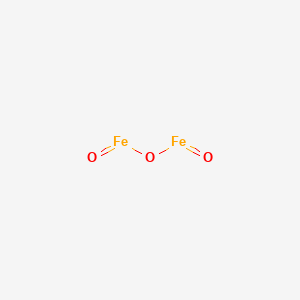
- IUPAC-Name
- oxo(oxoferriooxy)iron
- Summenformel
- Fe2O3
- Molekulargewicht
- 159.69 g/mol
- Exakte Masse
- 159.854615 Da
- Topologische polare Oberfläche
- 43,4 Ų
- Wasserstoffbrücken-Donoren
- 0
- Wasserstoffbrücken-Akzeptoren
- 3
- Kovalente Einheiten
- 1
- Definierte Stereozentren
- 0
Auch bekannt als
16 weitere gemeldete Namen
Kennungen in externen Datenbanken
- ChEBI:CHEBI:50819
Belege aus weiteren wissenschaftlichen Datenbanken
NIH PubChem PUG-View
Attributed physical-property, hazard, environmental and use annotations.
- Color/Form: Reddish-brown hexagonal crystals Quelle: Hazardous Substances Data Bank (HSDB)
- Color/Form: Reddish or blueish-black powder Quelle: Hazardous Substances Data Bank (HSDB)
- Color/Form: Steel gray to red hexagonal Quelle: Hazardous Substances Data Bank (HSDB)
- Color/Form: Red-brown solid. /Iron oxide dust and fume, as Fe/ Quelle: Hazardous Substances Data Bank (HSDB)
- Color/Form: A fine, red powder of ferric oxide. /Rouge/ Quelle: Hazardous Substances Data Bank (HSDB)
- Density: 5.25 g/cu cm Quelle: Hazardous Substances Data Bank (HSDB)
- Density: 5.24 g/cm³ Quelle: ILO-WHO International Chemical Safety Cards (ICSCs)
- Density: 5.24 Quelle: Occupational Safety and Health Administration (OSHA)
- Density: 5.24 Quelle: The National Institute for Occupational Safety and Health (NIOSH)
- Melting Point: Iron 2664 °F Quelle: Haz-Map, Information on Hazardous Chemicals and Occupational Diseases
- Melting Point: 1539 °C Quelle: Hazardous Substances Data Bank (HSDB)
- Melting Point: 1565 °C Quelle: ILO-WHO International Chemical Safety Cards (ICSCs)
- Melting Point: 2664 °F Quelle: Occupational Safety and Health Administration (OSHA)
- Melting Point: 2664 °F Quelle: The National Institute for Occupational Safety and Health (NIOSH)
- Melting Point: 2849 °F Quelle: The National Institute for Occupational Safety and Health (NIOSH)
- Physical Description: Dry Powder; Other Solid; Dry Powder; Large Crystals; Liquid; Liquid; Dry Powder; Large Crystals; Liquid; Wet Solid; Other Solid; CBI; Large Crystals; Wet Solid; Other Solid; Dry Powder Quelle: EPA Chemical Data Reporting (CDR)
- Physical Description: Reddish-brown solid; Note: Exposure to fume may occur during the arc-welding of iron; [NIOSH] Insoluble in water; [CHEMINFO] Quelle: Haz-Map, Information on Hazardous Chemicals and Occupational Diseases
- Physical Description: REDDISH BROWN-TO-BLACK CRYSTALS OR POWDER. Quelle: ILO-WHO International Chemical Safety Cards (ICSCs)
- Physical Description: Reddish-brown solid. Quelle: Occupational Safety and Health Administration (OSHA)
- Physical Description: Reddish-brown solid. [Note: Exposure to fume may occur during the arc-welding of iron.] Quelle: The National Institute for Occupational Safety and Health (NIOSH)
- Physical Description: A fine, red powder of ferric oxide. [Note: Usually used in cake form or impregnated in paper or cloth.] Quelle: The National Institute for Occupational Safety and Health (NIOSH)
- Refractive Index: Index of refraction: 3.01, 2.94 (LI) Quelle: Hazardous Substances Data Bank (HSDB)
- Solubility: Soluble in acids; insoluble in water, alcohol, ether Quelle: Hazardous Substances Data Bank (HSDB)
- Solubility: Solubility in water: none Quelle: ILO-WHO International Chemical Safety Cards (ICSCs)
- Solubility: Insoluble Quelle: The National Institute for Occupational Safety and Health (NIOSH)
- Vapor Pressure: 0 mm Hg (approximate) Quelle: Hazardous Substances Data Bank (HSDB)
- Vapor Pressure: 0 mmHg (approx) Quelle: Occupational Safety and Health Administration (OSHA)
- Vapor Pressure: 0 mmHg (approx) Quelle: The National Institute for Occupational Safety and Health (NIOSH)
- IARC Carcinogenic Agent: Ferric oxide Quelle: International Agency for Research on Cancer (IARC)
- IARC Carcinogenic Classes: Group 3: Not classifiable as to its carcinogenicity to humans Quelle: International Agency for Research on Cancer (IARC)
- IARC Monographs: Volume 1: (1972) Some Inorganic Substances, Chlorinated Hydrocarbons, Aromatic Amines, N-Nitroso Compounds, and Natural Products; Volume Sup 7: Overall Evaluations of Carcinogenicity: An Updating of IARC Monographs Volumes 1 to 42, 1987; 440 pages; ISBN 92-832-1411-0 (out of print) Quelle: International Agency for Research on Cancer (IARC)
- Publication Year: 1987 Quelle: International Agency for Research on Cancer (IARC)
- Evaluation Year: 1987 Quelle: International Agency for Research on Cancer (IARC)
- Exposure Routes: inhalation Quelle: The National Institute for Occupational Safety and Health (NIOSH)
- Exposure Routes: inhalation, skin and/or eye contact Quelle: The National Institute for Occupational Safety and Health (NIOSH)
- First Aid: (General first aid procedures); Breathing: Respiratory support Quelle: The National Institute for Occupational Safety and Health (NIOSH)
- First Aid: (General first aid procedures); Eye: Irrigate immediately - If this chemical contacts the eyes, immediately wash (irrigate) the eyes with large amounts of water, occasionally lifting the lower and upper lids. Get medical attention immediately.; Breathing: Fresh air Quelle: The National Institute for Occupational Safety and Health (NIOSH)
- Note: This chemical does not meet GHS hazard criteria for 66.9% (2296 of 3433) of all reports. Quelle: European Chemicals Agency (ECHA)
- Signal: Warning Quelle: European Chemicals Agency (ECHA)
- GHS Hazard Statements: H319 (18.5%): Causes serious eye irritation [Warning Serious eye damage/eye irritation]; H411 (12%): Toxic to aquatic life with long lasting effects [Hazardous to the aquatic environment, long-term hazard] Quelle: European Chemicals Agency (ECHA)
- Precautionary Statement Codes: P264+P265, P273, P280, P305+P351+P338, P337+P317, P391, and P501 (click each P-code to see the statement) Quelle: European Chemicals Agency (ECHA)
- ECHA C&L Notifications Summary: Aggregated GHS information provided per 3433 reports by companies from 44 notifications to the ECHA C&L Inventory. Each notification may be associated with multiple companies.; Reported as not meeting GHS hazard criteria per 2296 of 3433 reports by companies.; There are 40 notifications provided by 1137 of 3433 reports by companies with hazard statement code(s).; Information may vary between notifications depending on impurities, additives, and other factors. The percentage value in parenthesis indicates the notified classification ratio from companies that provide hazard codes. Only hazard codes with percentage values above 10% are shown. For more detailed information, please visit ECHA C&L website. Quelle: European Chemicals Agency (ECHA)
- Signal: Danger Quelle: NITE-CMC
- GHS Hazard Statements: H370: Causes damage to organs [Danger Specific target organ toxicity, single exposure]; H372: Causes damage to organs through prolonged or repeated exposure [Danger Specific target organ toxicity, repeated exposure] Quelle: NITE-CMC
- Precautionary Statement Codes: P260, P264, P270, P308+P316, P319, P321, P405, and P501 (click each P-code to see the statement) Quelle: NITE-CMC
- GHS Hazard Statements: H315: Causes skin irritation [Warning Skin corrosion/irritation]; H318: Causes serious eye damage [Danger Serious eye damage/eye irritation]; H335: May cause respiratory irritation [Warning Specific target organ toxicity, single exposure; Respiratory tract irritation]; H372: Causes damage to organs through prolonged or repeated exposure [Danger Specific target organ toxicity, repeated exposure] Quelle: NITE-CMC
- Precautionary Statement Codes: P260, P261, P264, P264+P265, P270, P271, P280, P302+P352, P304+P340, P305+P354+P338, P317, P319, P321, P332+P317, P362+P364, P403+P233, P405, and P501 (click each P-code to see the statement) Quelle: NITE-CMC
- Target Organs: respiratory system Quelle: The National Institute for Occupational Safety and Health (NIOSH)
- Target Organs: Eyes, skin, respiratory system Quelle: The National Institute for Occupational Safety and Health (NIOSH)
- Consumer Uses: Other; Soil amendments (fertilizers); Catalyst; Filler; Not Known or Reasonably Ascertainable; Pigment; Intermediate; Dye Quelle: EPA Chemical Data Reporting (CDR)
- Industry Uses: Reducing agent; Soil amendments (fertilizers); Catalyst; Not Known or Reasonably Ascertainable; Filler; Oxidizing agent; Adsorbent; Laboratory chemicals; Dye; Pigment; Solids separation (precipitating) agent, not otherwise specified; Intermediate; Heat stabilizer; Processing aids, specific to petroleum production; Other; Alloys; Abrasives Quelle: EPA Chemical Data Reporting (CDR)
- Sources/Uses: Iron oxide is used in pigments, abrasives (jeweler's rouge), and magnetic tapes. Exposure can occur in mining, smelting, grinding steel, polishing, and welding; [ACGIH] Quelle: Haz-Map, Information on Hazardous Chemicals and Occupational Diseases
- Industrial Processes with risk of exposure: Steel Producing [Category: Industry]; Abrasive Blasting [Category: Clean]; Metal Preparation and Pouring [Category: Foundry]; Welding [Category: Weld]; Painting (Pigments, Binders, and Biocides) [Category: Paint]; Mining [Category: Industry]; Cement Producing [Category: Industry]; Metal Extraction and Refining [Category: Industry] Quelle: Haz-Map, Information on Hazardous Chemicals and Occupational Diseases
- Uses: Polishing agent for glass, precious metals, diamonds; in magnets, magnetic tapes; as catalyst; pigment for paper, linoleum, ceramics, glass; paint for ironwork, ship hulls; in electrical resistors and semiconductors; as colloidal solutions as stain for polysaccharides. Quelle: Hazardous Substances Data Bank (HSDB)
- Uses: As a pigment, mfr of ferrites for electronic uses. Quelle: Hazardous Substances Data Bank (HSDB)
- Uses: Metallurgy, gas purification, paint and rubber pigment, component of thermite, polishing compounds, mordant, lab reagent, catalyst (p-hydrogen), feed additive, electronic pigments for TV, permanent magnets, memory cores for computers, magnetic tapes. Quelle: Hazardous Substances Data Bank (HSDB)
- Uses: Used almost exclusively to color decorative concrete; in paints and coatings Quelle: Hazardous Substances Data Bank (HSDB)
- Uses: For more Uses (Complete) data for FERRIC OXIDE (8 total), please visit the HSDB record page. Quelle: Hazardous Substances Data Bank (HSDB)
Zugeordnet durch: Existing checksum-valid CAS to unique PubChem CID match. Abgerufen: 2026-08-31. Quelleneintrag öffnen
Wissenschaftliche Klassifizierungen und Gefahrenannotationen liefern Kontext und ersetzen nicht die oben gezeigte marktspezifische regulatorische Entscheidung.
Weitere Quellenabdeckung und Trefferstatus
| Quelle | Ergebnis | Geprüft |
|---|---|---|
| NIH PubChem PUG-View | Exakter Treffer | 2026-08-31 |
Ein erfasster Nicht-Treffer ist ein nützlicher Beleg dafür, dass die Quelle geprüft wurde; er ist keine Behauptung, dass der Stoff anderswo nicht existiert.
Am 2026-09-02 von NIH PubChem durch prüfsummengültigen CAS-Abgleich abgerufen. Chemische Eigenschaften ersetzen nicht die regulatorische Entscheidung auf dieser Seite.
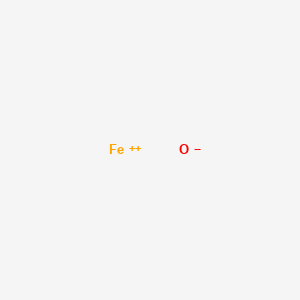
Ferrous oxide
- IUPAC-Name
- iron(2+);oxygen(2-)
- Summenformel
- FeO
- Molekulargewicht
- 71.84 g/mol
- Exakte Masse
- 71.929850 Da
- Topologische polare Oberfläche
- 1,0 Ų
- Wasserstoffbrücken-Donoren
- 0
- Wasserstoffbrücken-Akzeptoren
- 1
- Kovalente Einheiten
- 2
- Definierte Stereozentren
- 0
Auch bekannt als
9 weitere gemeldete Namen
Kennungen in externen Datenbanken
- EPA DTXSID:DTXSID1041976
Am 2026-09-02 von NIH PubChem durch prüfsummengültigen CAS-Abgleich abgerufen. Chemische Eigenschaften ersetzen nicht die regulatorische Entscheidung auf dieser Seite.
Verzeichnisverknüpfungen für Iron Oxide Black
CI 77491
CI 77492
CI 77499
Verwandte Einträge zu Iron Oxide Black
Für diesen Eintrag gibt es nur wenige direkte Treffer; daher werden auch nahe liegende Einträge aus Anhang IV angezeigt.
Was Anhang IV für Iron Oxide Black bedeutet
Iron Oxide Black ist ein zugelassener Farbstoff, der in Anhang IV der EU-Kosmetikverordnung (EG) Nr. 1223/2009 aufgeführt ist. Nur Farbstoffe dieser Positivliste dürfen zum Färben kosmetischer Mittel auf dem EU-Markt verwendet werden.
Einige Farbstoffe in Anhang IV sind nach Produktart beschränkt – zum Beispiel ist ihre Verwendung in Augennähe oder in Produkten, die auf Schleimhäuten angewendet werden, verboten. Prüfen Sie vor der Verwendung die oben genannten Felder zu Produktart und Bedingungen.
Dieser Eintrag ist zum Abgleich von Namen und Kennungen mit 5 Inhaltsstoffen des CosIng-Verzeichnisses verknüpft. Die Seite zeigt außerdem 10 verwandte Anhangseinträge mit überschneidenden Kennungen, Anhangslogik oder Namensmustern.
Compliance-Checkliste
- Prüfen Sie, dass der Farbstoff nur in den oben genannten zulässigen Produktarten verwendet wird.
- Geben Sie die Colour-Index-Nummer und die CAS-Kennung in der Inhaltsstoffangabe an.
Häufig gestellte Fragen
Quellenhinweis zu Anhang IV, Eintrag Iron Oxide Black
Diese Seite fasst einen Eintrag aus Anhang IV für Iron Oxide Black aus öffentlichen Materialien der Europäischen Kommission zu kosmetischen Mitteln zusammen und ergänzt, soweit verfügbar, verknüpfte Treffer aus dem Verzeichnis oder bei Kennungen.
Nutzen Sie diese Eintragsseite, um die Bedingungen aus Anhang IV für Iron Oxide Black zu prüfen; bestätigen Sie jede endgültige regulatorische Entscheidung jedoch anhand des aktuellen amtlichen Anhangswortlauts und der Quelldateien.
Werkzeuge und nächste Schritte
Rezeptur prüfen
Fügen Sie eine vollständige INCI-Liste ein, um Iron Oxide Black und andere markierte EU-Anhangseinträge in einem Durchgang zu finden.
INCI-CheckerEinträge vergleichen
Iron Oxide Black nebeneinander mit einem anderen Anhangseintrag vergleichen, um Unterschiede bei Beschränkungen, Konzentrationen und Anhangszuordnung zu prüfen.
VergleichenDen Anhang durchsuchen
Alle Einträge in Anhang IV ansehen und die regulatorischen Bedingungen der Stoffe in diesem Anhang vergleichen.
Anhang IV öffnen