
Hydroxyethyl-2-Nitro-p-Toluidine
2-(4-Methyl-2-nitroanilino)ethanol
Hydroxyethyl-2-Nitro-p-Toluidine ist in Anhang III aufgeführt und darf nur unter den in diesem Eintrag genannten Bedingungen verwendet werden. Höchstkonzentration in diesem Eintrag: (b) 1,0%.
Eintragsdetails
Höchstkonzentration
(b) 1,0%
Produktart
Sonstige Beschränkungen
(a) After mixing under oxidative conditions the maximum concentration applied to hair must not exceed 1,0%
For (a) and (b):
- Do not use with nitrosating agents
- Maximum nitrosamine content 50 microgram/Kg
- Keep in nitrite-free containers
Warnhinweise
To be printed on the label:
Hair colorants can use severe allergic reactions
INCI-Glossarname
Hydroxyethyl-2-Nitro-p-Toluidine
Chemische Bezeichnung
2-(4-Methyl-2-nitroanilino)ethanol
Chemische / IUPAC-Bezeichnung
2-(4-Methyl-2-nitroanilino)ethanol
Regulatorische Informationen
Kerndaten
Chemische Identität und Eigenschaften
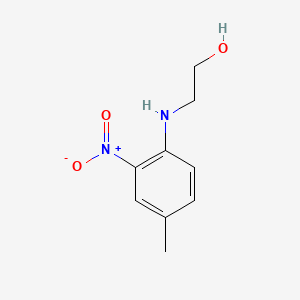
Hydroxyethyl-2-nitro-p-toluidine
- IUPAC-Name
- 2-(4-methyl-2-nitroanilino)ethanol
- Summenformel
- C9H12N2O3
- Molekulargewicht
- 196.20 g/mol
- Exakte Masse
- 196.08479225 Da
- XLogP3
- 1,6
- Topologische polare Oberfläche
- 78,1 Ų
- Wasserstoffbrücken-Donoren
- 2
- Wasserstoffbrücken-Akzeptoren
- 4
- Kovalente Einheiten
- 1
- Definierte Stereozentren
- 0
Auch bekannt als
16 weitere gemeldete Namen
Kennungen in externen Datenbanken
- EPA DTXSID:DTXSID20143261
Belege aus weiteren wissenschaftlichen Datenbanken
NIH PubChem PUG-View
Attributed physical-property, hazard, environmental and use annotations.
- Signal: Warning Quelle: Regulation (EC) No 1272/2008 of the European Parliament and of the Council
- GHS Hazard Statements: H302: Harmful if swallowed [Warning Acute toxicity, oral]; H317: May cause an allergic skin reaction [Warning Sensitization, Skin]; H412: Harmful to aquatic life with long lasting effects [Hazardous to the aquatic environment, long-term hazard] Quelle: Regulation (EC) No 1272/2008 of the European Parliament and of the Council
- Precautionary Statement Codes: P261, P264, P270, P272, P273, P280, P301+P317, P302+P352, P321, P330, P333+P317, P362+P364, and P501 (click each P-code to see the statement) Quelle: Regulation (EC) No 1272/2008 of the European Parliament and of the Council
- Signal: Warning Quelle: European Chemicals Agency (ECHA)
- GHS Hazard Statements: H302 (100%): Harmful if swallowed [Warning Acute toxicity, oral]; H317 (100%): May cause an allergic skin reaction [Warning Sensitization, Skin]; H412 (100%): Harmful to aquatic life with long lasting effects [Hazardous to the aquatic environment, long-term hazard] Quelle: European Chemicals Agency (ECHA)
- Precautionary Statement Codes: P261, P264, P270, P272, P273, P280, P301+P317, P302+P352, P321, P330, P333+P317, P362+P364, and P501 (click each P-code to see the statement) Quelle: European Chemicals Agency (ECHA)
- ECHA C&L Notifications Summary: Aggregated GHS information provided per 61 reports by companies from 2 notifications to the ECHA C&L Inventory. Each notification may be associated with multiple companies.; Information may vary between notifications depending on impurities, additives, and other factors. The percentage value in parenthesis indicates the notified classification ratio from companies that provide hazard codes. Only hazard codes with percentage values above 10% are shown. For more detailed information, please visit ECHA C&L website. Quelle: European Chemicals Agency (ECHA)
- ECHA C&L Notifications Summary: The GHS information provided by 1 company from 1 notification to the ECHA C&L Inventory. Quelle: European Chemicals Agency (ECHA)
- Signal: Warning Quelle: Hazardous Chemical Information System (HCIS), Safe Work Australia
- GHS Hazard Statements: H302: Harmful if swallowed [Warning Acute toxicity, oral]; H317: May cause an allergic skin reaction [Warning Sensitization, Skin]; H412: Harmful to aquatic life with long lasting effects [Hazardous to the aquatic environment, long-term hazard] Quelle: Hazardous Chemical Information System (HCIS), Safe Work Australia
- Precautionary Statement Codes: P261, P264, P270, P272, P273, P280, P301+P317, P302+P352, P321, P330, P333+P317, P362+P364, and P501 (click each P-code to see the statement) Quelle: Hazardous Chemical Information System (HCIS), Safe Work Australia
Zugeordnet durch: Existing checksum-valid CAS to unique PubChem CID match. Abgerufen: 2026-08-31. Quelleneintrag öffnen
Wissenschaftliche Klassifizierungen und Gefahrenannotationen liefern Kontext und ersetzen nicht die oben gezeigte marktspezifische regulatorische Entscheidung.
Weitere Quellenabdeckung und Trefferstatus
| Quelle | Ergebnis | Geprüft |
|---|---|---|
| EMBL-EBI ChEBI | Kein exakter Eintrag | 2026-08-31 |
| NIH PubChem PUG-View | Exakter Treffer | 2026-08-31 |
Ein erfasster Nicht-Treffer ist ein nützlicher Beleg dafür, dass die Quelle geprüft wurde; er ist keine Behauptung, dass der Stoff anderswo nicht existiert.
Am 2026-09-02 von NIH PubChem durch prüfsummengültigen CAS-Abgleich abgerufen. Chemische Eigenschaften ersetzen nicht die regulatorische Entscheidung auf dieser Seite.
Verzeichnisverknüpfungen für Hydroxyethyl-2-Nitro-p-Toluidine
HYDROXYETHYL-2-NITRO-P-TOLUIDINE
Verwandte Einträge zu Hydroxyethyl-2-Nitro-p-Toluidine
N-substituted derivatives of p- Phenylenediamine and their salts; N- substituted derivatives of o-P…
p-Phenylenediamine and its salts
N,N'-BIS(2-HYDROXYETHYL)-2-NITRO-P-PHENYLENEDIAMINE
Methylphenylenediamines, their N-substituted derivatives and their salts (1) with the exception of …
Methylphenylenediamines, their N- substituted derivatives and their salts (1), with the exception o…
CI 19140 / ACID YELLOW 23
ACID BLUE 9
Was Anhang III für Hydroxyethyl-2-Nitro-p-Toluidine bedeutet
Hydroxyethyl-2-Nitro-p-Toluidine ist ein beschränkter Stoff nach Anhang III der EU-Kosmetikverordnung (EG) Nr. 1223/2009. Seine Verwendung in kosmetischen Mitteln ist nur unter den im obigen Eintrag genannten besonderen Bedingungen zulässig, einschließlich geltender Konzentrationsgrenzen, Beschränkungen der Produktart und erforderlicher Warnhinweise.
Wird dieser Stoff in einer Rezeptur verwendet, müssen alle Bedingungen – Höchstkonzentration, Produktbereich und Warnhinweise – gleichzeitig erfüllt sein. Die Einhaltung einer Bedingung hebt die anderen nicht auf.
Dieser Eintrag ist zum Abgleich von Namen und Kennungen mit 1 Inhaltsstoff des CosIng-Verzeichnisses verknüpft. Die Seite zeigt außerdem 12 verwandte Anhangseinträge mit überschneidenden Kennungen, Anhangslogik oder Namensmustern.
Compliance-Checkliste
- Stellen Sie sicher, dass die Konzentration in der Rezeptur nicht überschreitet: (b) 1,0%
- Prüfen Sie die Vereinbarkeit mit der Produktart: (a) Hair dye substance in oxidative hair dye products (b) Hair dye substance in non-oxidative hair dye products
- Geben Sie den erforderlichen Warnhinweis auf dem Produktetikett an.
- Dokumentieren Sie die Verwendungsbedingungen in der Produktinformationsdatei (PIF).
Häufig gestellte Fragen
Quellenhinweis zu Anhang III, Eintrag Hydroxyethyl-2-Nitro-p-Toluidine
Diese Seite fasst einen Eintrag aus Anhang III für Hydroxyethyl-2-Nitro-p-Toluidine aus öffentlichen Materialien der Europäischen Kommission zu kosmetischen Mitteln zusammen und ergänzt, soweit verfügbar, verknüpfte Treffer aus dem Verzeichnis oder bei Kennungen.
Nutzen Sie diese Eintragsseite, um die Bedingungen aus Anhang III für Hydroxyethyl-2-Nitro-p-Toluidine zu prüfen; bestätigen Sie jede endgültige regulatorische Entscheidung jedoch anhand des aktuellen amtlichen Anhangswortlauts und der Quelldateien.
Werkzeuge und nächste Schritte
Rezeptur prüfen
Fügen Sie eine vollständige INCI-Liste ein, um Hydroxyethyl-2-Nitro-p-Toluidine und andere markierte EU-Anhangseinträge in einem Durchgang zu finden.
INCI-CheckerEinträge vergleichen
Hydroxyethyl-2-Nitro-p-Toluidine nebeneinander mit einem anderen Anhangseintrag vergleichen, um Unterschiede bei Beschränkungen, Konzentrationen und Anhangszuordnung zu prüfen.
VergleichenDen Anhang durchsuchen
Alle Einträge in Anhang III ansehen und die regulatorischen Bedingungen der Stoffe in diesem Anhang vergleichen.
Anhang III öffnen