
N-(5-chloro-2-isopropylbenzyl)-N-cyclopropyl-3-(difluoromethyl)-5-fluoro-1-methyl-1H-pyrazole-4-carboxamide; isoflucypram
N-(5-chloro-2-isopropylbenzyl)-N-cyclopropyl-3-(difluoromethyl)-5-fluoro-1-methyl-1H-pyrazole-4-carboxamide; isoflucypram ist in Anhang II als verbotener Stoff für kosmetische Mittel aufgeführt, die in der EU in Verkehr gebracht werden.
Eintragsdetails
Chemische Bezeichnung
N-(5-chloro-2-isopropylbenzyl)-N-cyclopropyl-3-(difluoromethyl)-5-fluoro-1-methyl-1H-pyrazole-4-carboxamide; isoflucypram
Regulatorische Informationen
Kerndaten
Chemische Identität und Eigenschaften
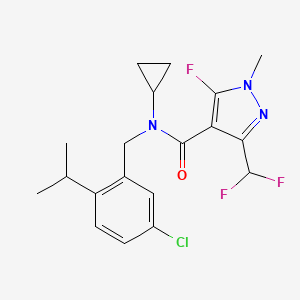
Isoflucypram
Isoflucypram is a tertiary carboxamide resulting from the formal condensation of the carboxy group of 3-(difluoromethyl)-5-fluoro-1-methyl-1H-pyrazole-4-carboxylic acid with the amino group of N-[5-chloro-2-(propan-2-yl)benzyl]cyclopropanamine. It is a broad spectrum fungicide developed by Bayer that exhibits high efficacy against the major fungal diseases of cereal crops (wheat, triticale, rye, barley and oats). It has a role as an EC 1.3.5.1 [succinate dehydrogenase (quinone)] inhibitor and an antifungal agrochemical. It is a tertiary carboxamide, a member of pyrazoles, an organofluorine pesticide, an alkylbenzene, a tertiary amino compound, a member of cyclopropanes and a member of monochlorobenzenes. — ChEBI
- IUPAC-Name
- N-[(5-chloro-2-propan-2-ylphenyl)methyl]-N-cyclopropyl-3-(difluoromethyl)-5-fluoro-1-methylpyrazole-4-carboxamide
- Summenformel
- C19H21ClF3N3O
- Molekulargewicht
- 399.8 g/mol
- Exakte Masse
- 399.1325245 Da
- XLogP3
- 4,6
- Topologische polare Oberfläche
- 38,1 Ų
- Wasserstoffbrücken-Donoren
- 0
- Wasserstoffbrücken-Akzeptoren
- 5
- Kovalente Einheiten
- 1
- Definierte Stereozentren
- 0
Auch bekannt als
10 weitere gemeldete Namen
Kennungen in externen Datenbanken
- ChEBI:CHEBI:228225
- EPA DTXSID:DTXSID301023707
Belege aus weiteren wissenschaftlichen Datenbanken
NIH PubChem PUG-View
Attributed physical-property, hazard, environmental and use annotations.
- Signal: Warning Quelle: Regulation (EC) No 1272/2008 of the European Parliament and of the Council
- GHS Hazard Statements: H317: May cause an allergic skin reaction [Warning Sensitization, Skin]; H332: Harmful if inhaled [Warning Acute toxicity, inhalation]; H361f: Suspected of damaging fertility [Warning Reproductive toxicity]; H400: Very toxic to aquatic life [Warning Hazardous to the aquatic environment, acute hazard]; H410: Very toxic to aquatic life with long lasting effects [Warning Hazardous to the aquatic environment, long-term hazard] Quelle: Regulation (EC) No 1272/2008 of the European Parliament and of the Council
- Precautionary Statement Codes: P203, P261, P271, P272, P273, P280, P302+P352, P304+P340, P317, P318, P321, P333+P317, P362+P364, P391, P405, and P501 (click each P-code to see the statement) Quelle: Regulation (EC) No 1272/2008 of the European Parliament and of the Council
- Signal: Warning Quelle: European Chemicals Agency (ECHA)
- GHS Hazard Statements: H317 (100%): May cause an allergic skin reaction [Warning Sensitization, Skin]; H332 (100%): Harmful if inhaled [Warning Acute toxicity, inhalation]; H361f (64.4%): Suspected of damaging fertility [Warning Reproductive toxicity]; H373 (62.2%): May causes damage to organs through prolonged or repeated exposure [Warning Specific target organ toxicity, repeated exposure]; H400 (100%): Very toxic to aquatic life [Warning Hazardous to the aquatic environment, acute hazard]; H410 (100%): Very toxic to aquatic life with long lasting effects [Warning Hazardous to the aquatic environment, long-term hazard] Quelle: European Chemicals Agency (ECHA)
- Precautionary Statement Codes: P203, P260, P261, P271, P272, P273, P280, P302+P352, P304+P340, P317, P318, P319, P321, P333+P317, P362+P364, P391, P405, and P501 (click each P-code to see the statement) Quelle: European Chemicals Agency (ECHA)
- ECHA C&L Notifications Summary: Aggregated GHS information provided per 45 reports by companies from 3 notifications to the ECHA C&L Inventory. Each notification may be associated with multiple companies.; Information may vary between notifications depending on impurities, additives, and other factors. The percentage value in parenthesis indicates the notified classification ratio from companies that provide hazard codes. Only hazard codes with percentage values above 10% are shown. For more detailed information, please visit ECHA C&L website. Quelle: European Chemicals Agency (ECHA)
Zugeordnet durch: Existing checksum-valid CAS to unique PubChem CID match. Abgerufen: 2026-08-31. Quelleneintrag öffnen
Wissenschaftliche Klassifizierungen und Gefahrenannotationen liefern Kontext und ersetzen nicht die oben gezeigte marktspezifische regulatorische Entscheidung.
Weitere Quellenabdeckung und Trefferstatus
| Quelle | Ergebnis | Geprüft |
|---|---|---|
| NIH PubChem PUG-View | Exakter Treffer | 2026-08-31 |
Ein erfasster Nicht-Treffer ist ein nützlicher Beleg dafür, dass die Quelle geprüft wurde; er ist keine Behauptung, dass der Stoff anderswo nicht existiert.
Am 2026-09-02 von NIH PubChem durch prüfsummengültigen CAS-Abgleich abgerufen. Chemische Eigenschaften ersetzen nicht die regulatorische Entscheidung auf dieser Seite.
Verwandte Einträge zu N-(5-chloro-2-isopropylbenzyl)-N-cyclopropyl-3-(difluoromethyl)-5-fluoro-1-methyl-1H-pyrazole-4-carboxamide; isoflucypram
Für diesen Eintrag gibt es nur wenige direkte Treffer; daher werden auch nahe liegende Einträge aus Anhang II angezeigt.
N-(2-nitrophenyl)phosphoric triamide
Reaction mass of 3-(difluoromethyl)-1-methyl-N-[(1RS,4SR,9RS)-1,2,3,4-tetrahydro-9-isopropyl-1,4-me…
Fluopicolide (ISO); 2,6-dichloro-N-[3-chloro-5-(trifluoromethyl)-2-pyridylmethyl]benzamide
Margosa, ext. [from the kernels of Azadirachta indica extracted with water and further processed wi…
1,3,5-triazine-2,4,6-triamine; melamine
Theophylline; 1,3-dimethyl-3,7-dihydro-1H-purine-2,6-dione
2-ethyl-2-[[(1-oxoallyl)oxy]methyl]-1,3-propanediyl diacrylate; 2,2-bis(acryloyloxymethyl)butyl acr…
6-[C12-18-alkyl-(branched, unsaturated)-2,5-dioxopyrrolidin-1-yl]hexanoic acid
Pentapotassium 2,2’,2’’,2’’’,2’’’’-(ethane-1,2-diylnitrilo)pentaacetate
6-[(C10-C13)-alkyl-(branched, unsaturated)-2,5-dioxopyrrolidin-1-yl]hexanoic acid
N-carboxymethyliminobis(ethylenenitrilo)tetra(acetic acid); Pentetic Acid (INCI)
Was Anhang II für N-(5-chloro-2-isopropylbenzyl)-N-cyclopropyl-3-(difluoromethyl)-5-fluoro-1-methyl-1H-pyrazole-4-carboxamide; isoflucypram bedeutet
N-(5-chloro-2-isopropylbenzyl)-N-cyclopropyl-3-(difluoromethyl)-5-fluoro-1-methyl-1H-pyrazole-4-carboxamide; isoflucypram ist in Anhang II der EU-Kosmetikverordnung (EG) Nr. 1223/2009 als verbotener Stoff aufgeführt und darf nicht absichtlich zugesetzt werden. Artikel 17 regelt gesondert unbeabsichtigte geringe Mengen, die bei guter Herstellungspraxis technisch unvermeidbar und mit der Sicherheitsanforderung nach Artikel 3 vereinbar sind.
Rezepturentwickler müssen ihre Inhaltsstoffe und Rohstoffe prüfen, um sicherzustellen, dass keiner davon diesen Stoff enthält. Lieferanten sollten auf Anfrage eine Dokumentation vorlegen, die die Abwesenheit bestätigt.
Die Seite zeigt außerdem 12 verwandte Anhangseinträge mit überschneidenden Kennungen, Anhangslogik oder Namensmustern.
Compliance-Checkliste
- Prüfen Sie, dass dieser Stoff in allen Rohstoffen und fertigen Rezepturen nicht enthalten ist.
- Fordern Sie von Rohstofflieferanten eine Abwesenheitsbestätigung oder ein Analysenzertifikat an.
- Dokumentieren Sie das Prüfergebnis in der Produktinformationsdatei (PIF).
Häufig gestellte Fragen
Quellenhinweis zu Anhang II, Eintrag N-(5-chloro-2-isopropylbenzyl)-N-cyclopropyl-3-(difluoromethyl)-5-fluoro-1-methyl-1H-pyrazole-4-carboxamide; isoflucypram
Diese Seite fasst einen Eintrag aus Anhang II für N-(5-chloro-2-isopropylbenzyl)-N-cyclopropyl-3-(difluoromethyl)-5-fluoro-1-methyl-1H-pyrazole-4-carboxamide; isoflucypram aus öffentlichen Materialien der Europäischen Kommission zu kosmetischen Mitteln zusammen und ergänzt, soweit verfügbar, verknüpfte Treffer aus dem Verzeichnis oder bei Kennungen.
Nutzen Sie diese Eintragsseite, um die Bedingungen aus Anhang II für N-(5-chloro-2-isopropylbenzyl)-N-cyclopropyl-3-(difluoromethyl)-5-fluoro-1-methyl-1H-pyrazole-4-carboxamide; isoflucypram zu prüfen; bestätigen Sie jede endgültige regulatorische Entscheidung jedoch anhand des aktuellen amtlichen Anhangswortlauts und der Quelldateien.
Werkzeuge und nächste Schritte
Rezeptur prüfen
Fügen Sie eine vollständige INCI-Liste ein, um N-(5-chloro-2-isopropylbenzyl)-N-cyclopropyl-3-(difluoromethyl)-5-fluoro-1-methyl-1H-pyrazole-4-carboxamide; isoflucypram und andere markierte EU-Anhangseinträge in einem Durchgang zu finden.
INCI-CheckerEinträge vergleichen
N-(5-chloro-2-isopropylbenzyl)-N-cyclopropyl-3-(difluoromethyl)-5-fluoro-1-methyl-1H-pyrazole-4-carboxamide; isoflucypram nebeneinander mit einem anderen Anhangseintrag vergleichen, um Unterschiede bei Beschränkungen, Konzentrationen und Anhangszuordnung zu prüfen.
VergleichenDen Anhang durchsuchen
Alle Einträge in Anhang II ansehen und die regulatorischen Bedingungen der Stoffe in diesem Anhang vergleichen.
Anhang II öffnen